Indus Research
No Result
View All Result
Thursday, April 30, 2026
login
  • Home
  • About
    • Who We Are
    • Patrons
    • Governing Board
    • Advisors
    • Directors
    • Editorial Board
    • Support IIRF
  • Themes
    • International Relations & Security
      • Land Security
      • Maritime Security
      • Aerospace Security
      • Nuclear
      • Geopolitics
    • History
    • Military Doctrine & Strategy
      • Doctrines
      • Joint and Integrated Defence
      • Civil Military Relations
    • Science and Technology
      • Defence Technology
      • Industries and Society
      • Climate Change
      • Natural Resources
    • Economics and Commerce
      • Rare Earth
      • Maritime Economy
      • International Trade
    • Education
  • Focus Geographies
    • South Asian Connectivity & Cooperation
      • Afghanistan
      • Pakistan
      • Nepal
      • Bhutan
      • Bangladesh
      • Myanmar
      • Sri Lanka
      • Maldives
      • BIMSTEC
      • SAARC
      • SAGQ
      • BBIN
      • BRI
      • INSTC
      • IORA
      • MGC
      • IMT
    • Indo-Pacific
      • Indo-Pacific Economic Forum
      • QUAD
      • Oceania
      • IORA
      • Middle East
    • Indo-US Relations
    • Central Asia and Russia
  • Publications
    • Commentary
    • Issue Briefs
    • Research Paper
    • Monograph
    • Journal Articles
    • Books
    • Book reviews
    • Contributors
    • Submission Rules
    • IIRF Strategic Year Book – 2022-23
    • IIRF Strategic Yearbook – 2024
  • Membership
    • Membership Form
  • Indo-US Forum
  • Indian Knowledge System
    • Arts & Culture
    • Yoga & Health
    • Sanskrit Vedic Science Spirituality
  • IIRF Creativity Zone
  • Contact
  • Events & Media
    • IIRF EVENTS
    • US-India Business Connect 2025
    • WTC Utah’s India Trade Mission 2024 Gallery
    • Videos
  • language
    • Hindi
  • Home
  • About
    • Who We Are
    • Patrons
    • Governing Board
    • Advisors
    • Directors
    • Editorial Board
    • Support IIRF
  • Themes
    • International Relations & Security
      • Land Security
      • Maritime Security
      • Aerospace Security
      • Nuclear
      • Geopolitics
    • History
    • Military Doctrine & Strategy
      • Doctrines
      • Joint and Integrated Defence
      • Civil Military Relations
    • Science and Technology
      • Defence Technology
      • Industries and Society
      • Climate Change
      • Natural Resources
    • Economics and Commerce
      • Rare Earth
      • Maritime Economy
      • International Trade
    • Education
  • Focus Geographies
    • South Asian Connectivity & Cooperation
      • Afghanistan
      • Pakistan
      • Nepal
      • Bhutan
      • Bangladesh
      • Myanmar
      • Sri Lanka
      • Maldives
      • BIMSTEC
      • SAARC
      • SAGQ
      • BBIN
      • BRI
      • INSTC
      • IORA
      • MGC
      • IMT
    • Indo-Pacific
      • Indo-Pacific Economic Forum
      • QUAD
      • Oceania
      • IORA
      • Middle East
    • Indo-US Relations
    • Central Asia and Russia
  • Publications
    • Commentary
    • Issue Briefs
    • Research Paper
    • Monograph
    • Journal Articles
    • Books
    • Book reviews
    • Contributors
    • Submission Rules
    • IIRF Strategic Year Book – 2022-23
    • IIRF Strategic Yearbook – 2024
  • Membership
    • Membership Form
  • Indo-US Forum
  • Indian Knowledge System
    • Arts & Culture
    • Yoga & Health
    • Sanskrit Vedic Science Spirituality
  • IIRF Creativity Zone
  • Contact
  • Events & Media
    • IIRF EVENTS
    • US-India Business Connect 2025
    • WTC Utah’s India Trade Mission 2024 Gallery
    • Videos
  • language
    • Hindi
No Result
View All Result
Indus Research
No Result
View All Result
Home Academics

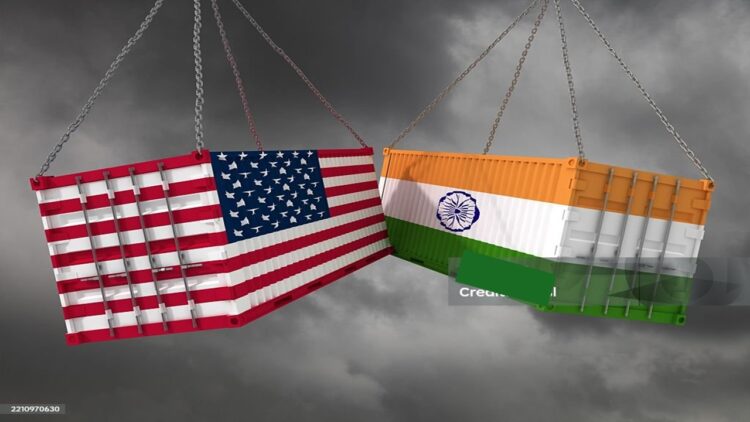
Will the US Imposition of Punitive Tariff of 25 % Hurt India ? – By C.M.A. Nayar

by CMA Nayar
August 5, 2025
in Academics, Commentary, Economics and Commerce, Geopolitics, Indo-US finance and investment, Indo-US forum, International Relations & Security, Uncategorized
0
Will the US Imposition of Punitive Tariff of 25 % Hurt India ?  – By  C.M.A. Nayar
Total
0
Shares
Share 0
Tweet 0
Share 0
Share 0
Share 0

The short answer is that India will be able to manage the shock  if it makes the right moves for protecting its interests

What could be India’s strategy ?

1.Global environment for trade

1.1. India has to make a quick assessment of the global environment of trade and recognize the reality that Globalization is fast approaching its death and India’s growth -strategy will have to depend on domestic consumption and not on exports. Exports should be primarily for balancing the account on imports.  This also would mean that India’s GDP will not be influenced by foreign trade.

1.2. India has to recognize the  fact that free trade is not necessarily fair trade and India should protect its interests through carefully crafted bilateral trade- agreements . These agreements should be beneficial to both the partners and will lead to balanced trade with a few exceptions involving countries supplying crude oil and natural gas .

1.3. India had huge  deficits in merchandize trade in 2024/2025 with nine of its top ten trade-partners. USA is the only top trade-partner with which India has a trade surplus .The trade-defict with Russia , UAE,  Saudi Arabia and Iraq are related to import of crude oil / natural gas . India has to initiate actions for bridging the trade -gap with China, Indonesia, Singapore , Hong Kong and South Korea either through increased exports or reduced imports . It is normal that USA is asking India to bridge the trade gap . In short-term , it can happen only through reduction in exports to USA .

1.4.Actions for “ atmanirbhar ( self – reliance ) “  should be further accelerated to ensure that huge trade-deficits with  major-trade -partners should be bridged quickly through local production .

  1. Is the US demand for reducing the trade-gap reasonable ? .

In my view , the answer is YES. The real issue is how India achieves this requirement .

Can it be done with  :

  • The current level of Indian exports , ie , by increasing imports from USA to India ?
  • With reduction of exports to USA ?
  • A balanced trade with increased volume of trade ? .

Both the sides will have to find a mutually acceptable solution acknowledging  the fact that a durable solution should result in a win-win situation . In any case,  a one upmanship approach by either side will be detrimental to both . The US position is that the trade gap should be bridged through increased import of agricultural products by India . India has practical problems because it may hurt the interests of Indian farmers . Further ,India can not also accept genetically modified food items for import . It appears that the probable short term solutions could be that

  1. a) Indian products continue to be competitive in USA even with 25 % duty and penalty and hence there is no change in the situation . This depends entirely on US decisions on country-wise import tariff which change frequently . In any case, inflation consequent to imposition of tariff on goods imported from over 90 countries could be considerable .
  2. b) Indian exports to USA come down for balancing the trade . This could be painful for India in short term . The products involved could be Electrical machinery / sound and television recorders ( HS code 85 ) , Iron and steel ( HS code 75), Textiles ( HS code 63), Clothing accessories ( HS code 62 ) , Pharmaceuticals ( HS code 30), Pearls and jewellery ( HS code 71), Agricultural products like marine products , spices, natural rubber etc . India will have to find new clients for these as early as possible .
  3. US complaints of non-access to Indian market

US has been complaining that US exports very little to India because of difficulties for market-access.  USA is third biggest import-partner of India  behind China , UAE . Evidently , US complaint is not based on facts.

  1. USDA India Roadmap 2024

This is an interesting document prepared by US Department of Agriculture based on the trade negotiations with India for export of agricultural products . This document contains a number of workable solutions which are beneficial to both . An extract from the document is given below :

“ India presents an exciting long-term growth opportunity for a diverse range of U.S. exports:  animal-sourced protein, consumer-oriented products, cotton, dairy products, distilled spirits, and wine, ethanol, forest products, fresh and dried fruits, base materials for processing, pulses (lentils and chickpeas), seafood, tree nuts, soybean, soybean products, corn, distiller’s dried grains with solubles (DDGS), as well as turkey and duck” .

India and USA will have to sit together and work out a mutually beneficial agreement .

  1. Can USA be a strategic partner for India for trade ?

The answer is NO . In fact, past experiences show without any ambiguity that relations with USA can only be transactional .Trade is not an exception . Further,  a bilateral trade agreement with USA does not mean much because USA has the habit of revoking agreements unilaterally as was the case with NAFTA / USMCA. The statements by American politicians like “ US will crush Indian economy “ and India is a “ dead economy “  come more out of frustration in dealing with India’s independent positions without really understanding the resilience of India .

  1. Pakistan factor

It is well known that Pakistan has been a close partner of USA for over 7 decades. India knows that this close relationship continues to be so and recent confirmation of a US General during congress-hearing has reconfirmed this point .  The present statement that US will develop oilfields in Pakistan is a matter between USA and Pakistan and it will have nothing to do with India . It could turn up as another project similar to CPAC. USA knows very well that its attempts to exploit mineral wealth in Afghanistan ended in a fiasco . The new project for  exploration of oil in Pakistan may also end up in the same manner . India will have nothing to do it .

  1. Conclusions

6.1.India has to plan its growth-strategy based on domestic consumption and not on export

6.2. India has a trade deficit in 2024/2025 with nine out of its top 10 trade-partners. USA which is the top-most trade partner of India is one of them . India has to work out pragmatic solutions for bridging the trade gap with these nations in a timebound manner .

6.3. the competitiveness of Indian products after the imposition of the duty of 25 % will depend on the tariffs applied to other nations which are also suppliers of USA.

6.4. As a pragmatic step , India should be prepared to accept the fact that Indian exports to USA will come down and India should find adapted solutions

6.5. According the privilege to be the Most Favoured Nation to any country by USA is its choice . India is not likely to be one . US companies shifting manufacturing activities from China are going to Vietnam and this trend will continue . In my view,  US companies will come to India only if the Indian market is large enough to justify such an investment

6.6. As a nation , India has enough resilience to counter the US threats on trade.


Author – C.M.A.Nayar

Trivandrum , Kerala, India .

1st August 2025

Total
0
Shares
Share 0
Tweet 0
Pin it 0
Share 0
Share 0

Leave a Reply Cancel reply

Your email address will not be published. Required fields are marked *

Recent Posts

BREAKING GLASS CEILING – Col Vijaykant Chenji (Retd)

BREAKING GLASS CEILING – Col Vijaykant Chenji (Retd)

April 21, 2026
Lessons For India: Learning From USA-Iran War – by Brigadier Hemant Mahajan (Retd)

Lessons For India: Learning From USA-Iran War – by Brigadier Hemant Mahajan (Retd)

April 21, 2026
WAR WITHOUT FRONTIERS : How Modern Conflict is Redefining Victory  – by Col Vijay Chenji (Retd)

WAR WITHOUT FRONTIERS : How Modern Conflict is Redefining Victory – by Col Vijay Chenji (Retd)

April 5, 2026
Naval Confrontation in the Strait of Hormuz: American Aircraft Carriers vs Iran’s ‘Choke-Point’ Strategy – by Brigadier Hemant Mahajan

Naval Confrontation in the Strait of Hormuz: American Aircraft Carriers vs Iran’s ‘Choke-Point’ Strategy – by Brigadier Hemant Mahajan

April 4, 2026
From NATO to a New Security Structure in Europe – By C.M.A.Nayar

From NATO to a New Security Structure in Europe – By C.M.A.Nayar

March 31, 2026
Trump’s endgame: Could Israel bear the brunt of Iran conflict? – by Lt Gen C.A. Krishnan (retd)

Trump’s endgame: Could Israel bear the brunt of Iran conflict? – by Lt Gen C.A. Krishnan (retd)

March 24, 2026

<strong>About IIRF</strong>

Indus International Research Foundation is a New Delhi based organisation with its overseas centre at USA . It is part of a global network of scholars, professionals and veterans based in India and abroad. The Foundation focuses primarily on international relations, Indian heritage, political economy and security studies. Led by experts with decades of international and domestic policy experience, IIRF India engages with governments, policymakers, academics, students, industries, practitioners, and civil society to provide insightful and fresh analysis of global trends and India’s challenging role as an emerging world leader. Foundation also runs special programs for veterans.

Office Addresses

Delhi NCR
F-511, Jalvayu Towers, Sector-47, Noida, Gautam Budh Nagar, UP, India – 201301
Email – contact@indusresearch.in
Mobile :- +91 8588021407

USA
India International Research Foundation, 2105 Long Park Avenue Prosper 75078, Dallas, Texas, USA Email – infousa@indusresearch.in

Bangalore
Indus International Research Foundation, Parkside Brigade Orchards, Devanhalli, Bangalore, Karnataka -562110

Explore IIRF

  • Links
  • International Relations & Security
  • History
  • Military Doctrine & Strategy
  • Science and Technology
  • Economics and Commerce
  • Education
  • IIRF Creativity Zone
  • Membership
  • Support IIRF

© 2022 Indus Research

No Result
View All Result
  • Home
  • About
    • Who We Are
    • Patrons
    • Governing Board
    • Advisors
    • Directors
    • Editorial Board
    • Support IIRF
  • Themes
    • International Relations & Security
      • Land Security
      • Maritime Security
      • Aerospace Security
      • Nuclear
      • Geopolitics
    • History
    • Military Doctrine & Strategy
      • Doctrines
      • Joint and Integrated Defence
      • Civil Military Relations
    • Science and Technology
      • Defence Technology
      • Industries and Society
      • Climate Change
      • Natural Resources
    • Economics and Commerce
      • Rare Earth
      • Maritime Economy
      • International Trade
    • Education
  • Focus Geographies
    • South Asian Connectivity & Cooperation
      • Afghanistan
      • Pakistan
      • Nepal
      • Bhutan
      • Bangladesh
      • Myanmar
      • Sri Lanka
      • Maldives
      • BIMSTEC
      • SAARC
      • SAGQ
      • BBIN
      • BRI
      • INSTC
      • IORA
      • MGC
      • IMT
    • Indo-Pacific
      • Indo-Pacific Economic Forum
      • QUAD
      • Oceania
      • IORA
      • Middle East
    • Indo-US Relations
    • Central Asia and Russia
  • Publications
    • Commentary
    • Issue Briefs
    • Research Paper
    • Monograph
    • Journal Articles
    • Books
    • Book reviews
    • Contributors
    • Submission Rules
    • IIRF Strategic Year Book – 2022-23
    • IIRF Strategic Yearbook – 2024
  • Membership
    • Membership Form
  • Indo-US Forum
  • Indian Knowledge System
    • Arts & Culture
    • Yoga & Health
    • Sanskrit Vedic Science Spirituality
  • IIRF Creativity Zone
  • Contact
  • Events & Media
    • IIRF EVENTS
    • US-India Business Connect 2025
    • WTC Utah’s India Trade Mission 2024 Gallery
    • Videos
  • language
    • Hindi

© 2022 Indus Research