Indus Research
No Result
View All Result
Thursday, April 30, 2026
login
  • Home
  • About
    • Who We Are
    • Patrons
    • Governing Board
    • Advisors
    • Directors
    • Editorial Board
    • Support IIRF
  • Themes
    • International Relations & Security
      • Land Security
      • Maritime Security
      • Aerospace Security
      • Nuclear
      • Geopolitics
    • History
    • Military Doctrine & Strategy
      • Doctrines
      • Joint and Integrated Defence
      • Civil Military Relations
    • Science and Technology
      • Defence Technology
      • Industries and Society
      • Climate Change
      • Natural Resources
    • Economics and Commerce
      • Rare Earth
      • Maritime Economy
      • International Trade
    • Education
  • Focus Geographies
    • South Asian Connectivity & Cooperation
      • Afghanistan
      • Pakistan
      • Nepal
      • Bhutan
      • Bangladesh
      • Myanmar
      • Sri Lanka
      • Maldives
      • BIMSTEC
      • SAARC
      • SAGQ
      • BBIN
      • BRI
      • INSTC
      • IORA
      • MGC
      • IMT
    • Indo-Pacific
      • Indo-Pacific Economic Forum
      • QUAD
      • Oceania
      • IORA
      • Middle East
    • Indo-US Relations
    • Central Asia and Russia
  • Publications
    • Commentary
    • Issue Briefs
    • Research Paper
    • Monograph
    • Journal Articles
    • Books
    • Book reviews
    • Contributors
    • Submission Rules
    • IIRF Strategic Year Book – 2022-23
    • IIRF Strategic Yearbook – 2024
  • Membership
    • Membership Form
  • Indo-US Forum
  • Indian Knowledge System
    • Arts & Culture
    • Yoga & Health
    • Sanskrit Vedic Science Spirituality
  • IIRF Creativity Zone
  • Contact
  • Events & Media
    • IIRF EVENTS
    • US-India Business Connect 2025
    • WTC Utah’s India Trade Mission 2024 Gallery
    • Videos
  • language
    • Hindi
  • Home
  • About
    • Who We Are
    • Patrons
    • Governing Board
    • Advisors
    • Directors
    • Editorial Board
    • Support IIRF
  • Themes
    • International Relations & Security
      • Land Security
      • Maritime Security
      • Aerospace Security
      • Nuclear
      • Geopolitics
    • History
    • Military Doctrine & Strategy
      • Doctrines
      • Joint and Integrated Defence
      • Civil Military Relations
    • Science and Technology
      • Defence Technology
      • Industries and Society
      • Climate Change
      • Natural Resources
    • Economics and Commerce
      • Rare Earth
      • Maritime Economy
      • International Trade
    • Education
  • Focus Geographies
    • South Asian Connectivity & Cooperation
      • Afghanistan
      • Pakistan
      • Nepal
      • Bhutan
      • Bangladesh
      • Myanmar
      • Sri Lanka
      • Maldives
      • BIMSTEC
      • SAARC
      • SAGQ
      • BBIN
      • BRI
      • INSTC
      • IORA
      • MGC
      • IMT
    • Indo-Pacific
      • Indo-Pacific Economic Forum
      • QUAD
      • Oceania
      • IORA
      • Middle East
    • Indo-US Relations
    • Central Asia and Russia
  • Publications
    • Commentary
    • Issue Briefs
    • Research Paper
    • Monograph
    • Journal Articles
    • Books
    • Book reviews
    • Contributors
    • Submission Rules
    • IIRF Strategic Year Book – 2022-23
    • IIRF Strategic Yearbook – 2024
  • Membership
    • Membership Form
  • Indo-US Forum
  • Indian Knowledge System
    • Arts & Culture
    • Yoga & Health
    • Sanskrit Vedic Science Spirituality
  • IIRF Creativity Zone
  • Contact
  • Events & Media
    • IIRF EVENTS
    • US-India Business Connect 2025
    • WTC Utah’s India Trade Mission 2024 Gallery
    • Videos
  • language
    • Hindi
No Result
View All Result
Indus Research
No Result
View All Result
Home Commentary

Pakistan-Saudi Arabia defence deal: More symbolic than strategic? – by Lieutenant General C.A. Krishnan (Retd)

by Lt. Gen CA Krishnan
October 1, 2025
in Commentary, Geopolitics, International Relations & Security, Uncategorized
0
Pakistan-Saudi Arabia defence deal: More symbolic than strategic? – by Lieutenant General C.A. Krishnan (Retd)

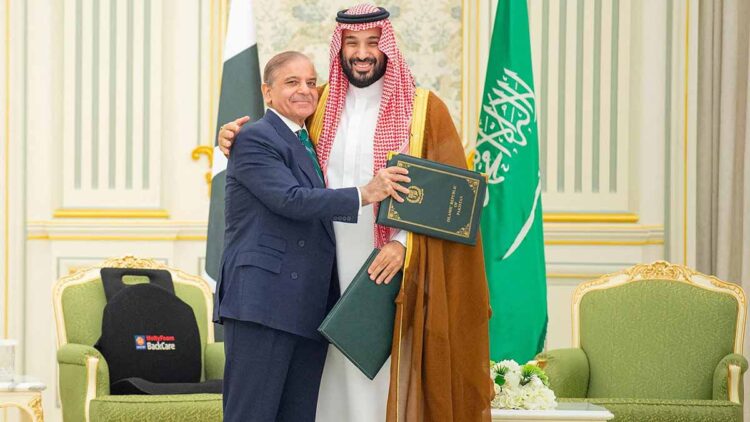
Collective defence: Saudi Crown Prince Mohammed bin Salman and Pakistan Prime Minister Shehbaz Sharif on the day the two countries signed the defence agreement | Reuters

Total
0
Shares
Share 0
Tweet 0
Share 0
Share 0
Share 0

The Pakistan-Saudi Arabia defence agreement is widely viewed as largely symbolic rather than possessing significant strategic military value, especially concerning any potential conflict with India. Despite its signing, Saudi Arabian assistance to Pakistan in such a scenario is unlikely to extend beyond additional oil supplies, financial aid, and mediatory diplomacy

THE PAKISTAN-SAUDI ARABIA “Strategic Mutual Defence Agreement” signed on September 17 came close on the heels of the Israeli airstrike on Hamas leaders in Doha. Although full details of the agreement are not known, the operative portion has been quoted as stating that “any aggression against either country shall be considered an aggression against both”.

Defence agreements are traditionally struck between a major power and one or more smaller powers, or when a group of nations brings together the collective military might through a structure like NATO. There is always a big power as the anchor, without which such agreements carry little weight. Viewed in this light, the Pakistan-Saudi Arabia agreement seems symbolic rather than one of strategic military value.

Any alliance in West Asia must factor in the US military bases across Saudi Arabia, Qatar, Bahrain, Kuwait and the UAE. These bases, with over 40,000 US troops, support air and naval operations, logistics and intelligence gathering. Saudi Arabia’s and the region’s security dependency on the US is significant.

The reliability of this dependency has, however, been repeatedly tested in recent years and the geopolitical realities of US security guarantees are beginning to look doubtful. The 2019 drone strikes by Iranian proxies on Saudi Arabian oil facilities attracted only a muted US response. Six years later, Trump’s pledge to “protect” Qatar, after it committed billions of dollars of investment in the US, proved of little use. Within months of this assurance came the first-ever direct Iranian strike and the first-ever Israeli strike on a Gulf state. Iran struck the US Al-Udeid air base in Qatar on June 23, followed by Israel’s strike on Hamas in the heart of Qatar on September 9.

These events have shaken West Asia’s confidence in existing security guarantees and caused immense embarrassment. US military bases are becoming more of a liability than an asset. Adding to the discomfort is the absence of any global condemnation, China maintaining a safe distance, Europe missing in action and Russia busy mopping up Ukraine.

From Pakistan’s perspective, the only military threat it faces is from India. Consider a scenario where, in retaliation for another Pakistan-sponsored terror attack, India launches Operation Sindoor-2. Would Saudi Arabia abandon its economic and diplomatic relations with India and become a direct party to an India-Pakistan war that Pakistan itself may have triggered? Would it risk destroying the diplomatic linkages and the image of a responsible global player that it has carefully built over decades, for little in return? Saudi Arabia’s military capacity and track record also make such a scenario highly improbable.

Even with the newly minted defence agreement in place, Saudi Arabian assistance to Pakistan in a war with India is unlikely to extend beyond some additional oil supplies, financial aid and mediatory diplomacy.

Decision dilemmas of this kind may explain why the full text of the agreement has not been released. It is possible that while the signing ceremony was rushed through for optics, the complexities of the body text are still being worked out. It would also be important to see how the agreement addresses aggression that may be precipitated by one of the signatories themselves.

The timing of the agreement suited Pakistan. Suddenly, it gains relevance in West Asia, something it has long sought. The deal gives Pakistan a larger-than-life image. Domestically, it strengthens the institutional weight of the army, deepens the military’s grip on governance and expands its role in foreign policy. The erosion of Pakistan’s democratic institutions and civilian authority continues.

The agreement reportedly includes defence industry collaboration, technology transfer and co-production. These aspects could bring access to funds and useful outcomes for Pakistan’s defence industries. This may be the only tangible benefit for Pakistan, apart from the image makeover.

In the Saudi Arabia-Israel context, it is unlikely that Riyadh perceives a direct threat from Israel, even in the form of a Doha-type strike. Nor is there any realistic scenario in which Saudi Arabia perceives a nuclear threat to itself. Its greater dilemma lies in reconciling its earlier overtures to Israel and its assertion that Palestine was not a priority. It must now balance this to maintain credibility as the Islamic world’s leader. Outwardly, the agreement provides good optics for Saudi Arabia, showing strategic autonomy and signalling displeasure with the US and Israel. It also conveys a subtle message of potential access to nuclear weapons if ever needed, especially given Saudi Arabia’s past financial role in Pakistan’s nuclear programme. Yet speculation about a Pakistani “nuclear umbrella” for Saudi Arabia is unrealistic, given that Pakistan possesses only a minimalist first-strike nuclear capability.

Syria, Yemen, Iraq and Iran, combined with active non-state actors operating from their territories, have made Saudi Arabia’s neighbourhood chaotic. These entities pose significant threats to its security. Problems could also arise from the mass Gaza exodus. One cannot rule out the emergence of trouble spots in and around Saudi Arabia, similar to Turkey’s Kurdish regions. Pakistan may be willing to assist Saudi Arabia in countering such challenges along its borders.

The only scenario in which the agreement looks militarily relevant is the Saudi Arabia-Iran context. The deal delivers a diplomatic and tactical blow to Tehran, Saudi Arabia’s main adversary. For Pakistan, however, it creates difficulties by deepening mistrust with its neighbour Iran.

This raises a question: is the agreement an American-engineered ploy with an eye on Iran?

Beyond the military sphere, Pakistan’s economy is a mess. Even maintaining its armed forces is proving financially burdensome. The country urgently needs an economic lifeline. An “on-call Wagner group” arrangement for its army may be one way to generate revenue.

Given the military capabilities of the signatories and the impact on regional power dynamics, the Pakistan-Saudi Arabia defence agreement appears more symbolic than strategic.

What is of greater importance is the writing on the wall: the existing security structure in the region has collapsed. The million-dollar question is what shape the new structure will take and how long it will take to emerge.

Saudi Arabia-Pakistan Mutual Defence Pact: Highlights

Core commitment

* Any aggression against either country would mean aggression against both

* Could extend to Pakistan’s nuclear capabilities

* Formalises decades-long defence cooperation

Saudi motivations

* Response to regional security breakdown after Israeli strike in Doha

* Reduce reliance on the US, diversify alliances

* Views Iran and Israel as threats, uses Pakistan’s nuclear status as deterrence

* Ambition to chart independent security path

ADVANTAGE PAKISTAN

* Cementing historic ties with Saudi Arabia

* Securing Saudi commitment in case of an Indian attack

* Likely Saudi financial support for Pakistan army

* Bolstering geopolitical standing

The India angle

* Makes cross-border operations against Pak risky

* Pact embeds Pakistan in West Asian security architecture

* Potential risk of a broadened anti-India alliance

* Saudi Arabia, however, maintains strong bilateral ties with India

* Pact reflects West Asian regional dynamics, not Indo-Pak conflict

Disclaimer and acknowledgement :- Views expressed are author’s own and does not represent the views of IIRF . This article was first published in The Week Magzine. This is an author’s authorised reprint. 

Total
0
Shares
Share 0
Tweet 0
Pin it 0
Share 0
Share 0

Leave a Reply Cancel reply

Your email address will not be published. Required fields are marked *

Recent Posts

BREAKING GLASS CEILING – Col Vijaykant Chenji (Retd)

BREAKING GLASS CEILING – Col Vijaykant Chenji (Retd)

April 21, 2026
Lessons For India: Learning From USA-Iran War – by Brigadier Hemant Mahajan (Retd)

Lessons For India: Learning From USA-Iran War – by Brigadier Hemant Mahajan (Retd)

April 21, 2026
WAR WITHOUT FRONTIERS : How Modern Conflict is Redefining Victory  – by Col Vijay Chenji (Retd)

WAR WITHOUT FRONTIERS : How Modern Conflict is Redefining Victory – by Col Vijay Chenji (Retd)

April 5, 2026
Naval Confrontation in the Strait of Hormuz: American Aircraft Carriers vs Iran’s ‘Choke-Point’ Strategy – by Brigadier Hemant Mahajan

Naval Confrontation in the Strait of Hormuz: American Aircraft Carriers vs Iran’s ‘Choke-Point’ Strategy – by Brigadier Hemant Mahajan

April 4, 2026
From NATO to a New Security Structure in Europe – By C.M.A.Nayar

From NATO to a New Security Structure in Europe – By C.M.A.Nayar

March 31, 2026
Trump’s endgame: Could Israel bear the brunt of Iran conflict? – by Lt Gen C.A. Krishnan (retd)

Trump’s endgame: Could Israel bear the brunt of Iran conflict? – by Lt Gen C.A. Krishnan (retd)

March 24, 2026

<strong>About IIRF</strong>

Indus International Research Foundation is a New Delhi based organisation with its overseas centre at USA . It is part of a global network of scholars, professionals and veterans based in India and abroad. The Foundation focuses primarily on international relations, Indian heritage, political economy and security studies. Led by experts with decades of international and domestic policy experience, IIRF India engages with governments, policymakers, academics, students, industries, practitioners, and civil society to provide insightful and fresh analysis of global trends and India’s challenging role as an emerging world leader. Foundation also runs special programs for veterans.

Office Addresses

Delhi NCR
F-511, Jalvayu Towers, Sector-47, Noida, Gautam Budh Nagar, UP, India – 201301
Email – contact@indusresearch.in
Mobile :- +91 8588021407

USA
India International Research Foundation, 2105 Long Park Avenue Prosper 75078, Dallas, Texas, USA Email – infousa@indusresearch.in

Bangalore
Indus International Research Foundation, Parkside Brigade Orchards, Devanhalli, Bangalore, Karnataka -562110

Explore IIRF

  • Links
  • International Relations & Security
  • History
  • Military Doctrine & Strategy
  • Science and Technology
  • Economics and Commerce
  • Education
  • IIRF Creativity Zone
  • Membership
  • Support IIRF

© 2022 Indus Research

No Result
View All Result
  • Home
  • About
    • Who We Are
    • Patrons
    • Governing Board
    • Advisors
    • Directors
    • Editorial Board
    • Support IIRF
  • Themes
    • International Relations & Security
      • Land Security
      • Maritime Security
      • Aerospace Security
      • Nuclear
      • Geopolitics
    • History
    • Military Doctrine & Strategy
      • Doctrines
      • Joint and Integrated Defence
      • Civil Military Relations
    • Science and Technology
      • Defence Technology
      • Industries and Society
      • Climate Change
      • Natural Resources
    • Economics and Commerce
      • Rare Earth
      • Maritime Economy
      • International Trade
    • Education
  • Focus Geographies
    • South Asian Connectivity & Cooperation
      • Afghanistan
      • Pakistan
      • Nepal
      • Bhutan
      • Bangladesh
      • Myanmar
      • Sri Lanka
      • Maldives
      • BIMSTEC
      • SAARC
      • SAGQ
      • BBIN
      • BRI
      • INSTC
      • IORA
      • MGC
      • IMT
    • Indo-Pacific
      • Indo-Pacific Economic Forum
      • QUAD
      • Oceania
      • IORA
      • Middle East
    • Indo-US Relations
    • Central Asia and Russia
  • Publications
    • Commentary
    • Issue Briefs
    • Research Paper
    • Monograph
    • Journal Articles
    • Books
    • Book reviews
    • Contributors
    • Submission Rules
    • IIRF Strategic Year Book – 2022-23
    • IIRF Strategic Yearbook – 2024
  • Membership
    • Membership Form
  • Indo-US Forum
  • Indian Knowledge System
    • Arts & Culture
    • Yoga & Health
    • Sanskrit Vedic Science Spirituality
  • IIRF Creativity Zone
  • Contact
  • Events & Media
    • IIRF EVENTS
    • US-India Business Connect 2025
    • WTC Utah’s India Trade Mission 2024 Gallery
    • Videos
  • language
    • Hindi

© 2022 Indus Research