Indus Research
No Result
View All Result
Saturday, May 16, 2026
login
  • Home
  • About
    • Who We Are
    • Patrons
    • Governing Board
    • Advisors
    • Directors
    • Editorial Board
    • Support IIRF
  • Themes
    • International Relations & Security
      • Land Security
      • Maritime Security
      • Aerospace Security
      • Nuclear
      • Geopolitics
    • History
    • Military Doctrine & Strategy
      • Doctrines
      • Joint and Integrated Defence
      • Civil Military Relations
    • Science and Technology
      • Defence Technology
      • Industries and Society
      • Climate Change
      • Natural Resources
    • Economics and Commerce
      • Rare Earth
      • Maritime Economy
      • International Trade
    • Education
  • Focus Geographies
    • South Asian Connectivity & Cooperation
      • Afghanistan
      • Pakistan
      • Nepal
      • Bhutan
      • Bangladesh
      • Myanmar
      • Sri Lanka
      • Maldives
      • BIMSTEC
      • SAARC
      • SAGQ
      • BBIN
      • BRI
      • INSTC
      • IORA
      • MGC
      • IMT
    • Indo-Pacific
      • Indo-Pacific Economic Forum
      • QUAD
      • Oceania
      • IORA
      • Middle East
    • Indo-US Relations
    • Central Asia and Russia
  • Publications
    • Commentary
    • Issue Briefs
    • Research Paper
    • Monograph
    • Journal Articles
    • Books
    • Book reviews
    • Contributors
    • Submission Rules
    • IIRF Strategic Year Book – 2022-23
    • IIRF Strategic Yearbook – 2024
  • Membership
    • Membership Form
  • Indo-US Forum
  • Indian Knowledge System
    • Arts & Culture
    • Yoga & Health
    • Sanskrit Vedic Science Spirituality
  • IIRF Creativity Zone
  • Contact
  • Events & Media
    • IIRF EVENTS
    • US-India Business Connect 2025
    • WTC Utah’s India Trade Mission 2024 Gallery
    • Videos
  • language
    • Hindi
  • Home
  • About
    • Who We Are
    • Patrons
    • Governing Board
    • Advisors
    • Directors
    • Editorial Board
    • Support IIRF
  • Themes
    • International Relations & Security
      • Land Security
      • Maritime Security
      • Aerospace Security
      • Nuclear
      • Geopolitics
    • History
    • Military Doctrine & Strategy
      • Doctrines
      • Joint and Integrated Defence
      • Civil Military Relations
    • Science and Technology
      • Defence Technology
      • Industries and Society
      • Climate Change
      • Natural Resources
    • Economics and Commerce
      • Rare Earth
      • Maritime Economy
      • International Trade
    • Education
  • Focus Geographies
    • South Asian Connectivity & Cooperation
      • Afghanistan
      • Pakistan
      • Nepal
      • Bhutan
      • Bangladesh
      • Myanmar
      • Sri Lanka
      • Maldives
      • BIMSTEC
      • SAARC
      • SAGQ
      • BBIN
      • BRI
      • INSTC
      • IORA
      • MGC
      • IMT
    • Indo-Pacific
      • Indo-Pacific Economic Forum
      • QUAD
      • Oceania
      • IORA
      • Middle East
    • Indo-US Relations
    • Central Asia and Russia
  • Publications
    • Commentary
    • Issue Briefs
    • Research Paper
    • Monograph
    • Journal Articles
    • Books
    • Book reviews
    • Contributors
    • Submission Rules
    • IIRF Strategic Year Book – 2022-23
    • IIRF Strategic Yearbook – 2024
  • Membership
    • Membership Form
  • Indo-US Forum
  • Indian Knowledge System
    • Arts & Culture
    • Yoga & Health
    • Sanskrit Vedic Science Spirituality
  • IIRF Creativity Zone
  • Contact
  • Events & Media
    • IIRF EVENTS
    • US-India Business Connect 2025
    • WTC Utah’s India Trade Mission 2024 Gallery
    • Videos
  • language
    • Hindi
No Result
View All Result
Indus Research
No Result
View All Result
Home Commentary

Naval Confrontation in the Strait of Hormuz: American Aircraft Carriers vs Iran’s ‘Choke-Point’ Strategy – by Brigadier Hemant Mahajan

by Brig Hemant Mahajan
April 4, 2026
in Commentary, Defence Technology, Economics and Commerce, Geopolitics, International Relations & Security, Maritime Security, Military Doctrine & Strategy, Uncategorized
0
Naval Confrontation in the Strait of Hormuz: American Aircraft Carriers vs Iran’s ‘Choke-Point’ Strategy – by Brigadier Hemant Mahajan
Total
0
Shares
Share 0
Tweet 0
Share 0
Share 0
Share 0
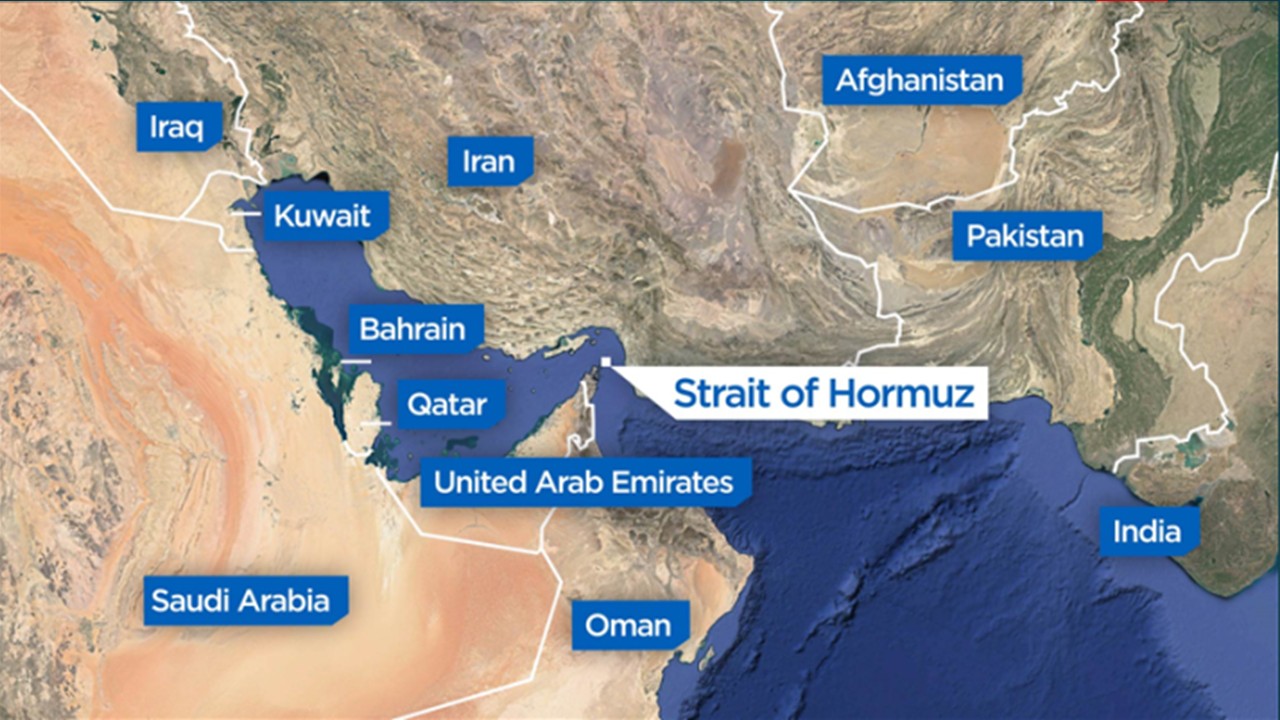
The Strait of Hormuz is highlighted as the narrow chokepoint connecting the Persian Gulf to the Gulf of Oman, with Iran to the north and Oman/UAE to the south. This is one of the most critical maritime passages in the world, as nearly 20% of global oil trade flows through it.

Naval Confrontation in the Strait of Hormuz:
American Aircraft Carriers vs Iran’s ‘Choke-Point’ Strategy

In the 2026 Iran–United States confrontation, the Arabian Gulf and the Strait of Hormuz have emerged as the central arena of both naval and geopolitical conflict. In this context, it is essential to analyze the role of the U.S. Navy—particularly its aircraft carrier operations—alongside Iran’s asymmetric “guerrilla-style” maritime tactics using fast attack boats. Equally important is the role of Gulf navies and the key lessons emerging from this evolving conflict.

Use of U.S. Naval Power and Aircraft Carriers

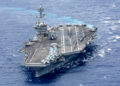
In the 2026 crisis, the backbone of U.S. naval power lies in multiple Carrier Strike Groups. Several U.S. Navy supercarriers—such as USS Gerald R. Ford, USS Abraham Lincoln, and USS George H. W. Bush—have been deployed in waters close to Iran. From these positions, their aircraft can launch strikes against Iranian military bases, missile sites, and naval infrastructure.

The role of these naval forces is not limited to offensive operations; they also provide security to allied nations in the Arabian Gulf. Aircraft carriers function as mobile airbases, enabling coordinated operations involving fighter jets, electronic warfare aircraft, AWACS, and strike drones. This integrated air-sea capability gives the United States significant long-range strike power and operational flexibility.

Gulf Navies: Limited Role

Navies of Gulf countries such as the United Arab Emirates, Saudi Arabia, Oman, Qatar, and Bahrain are actively deployed in the Strait of Hormuz and the wider Persian Gulf region. However, their role in the conflict has largely remained cooperative and defensive.

  • Logistical Support: These nations provide essential logistical support to U.S. and allied naval forces. Their airbases and ports serve as key hubs for sustaining operations of American supercarriers.
  • Coastal Security: Gulf states have strengthened coastal defenses and maintain constant patrols to monitor threats from Iranian fast attack boats.
  • Operational Constraints: These navies have largely avoided direct large-scale combat against Iran, focusing instead on securing maritime trade routes.

Iran’s Asymmetric Maritime Strategy

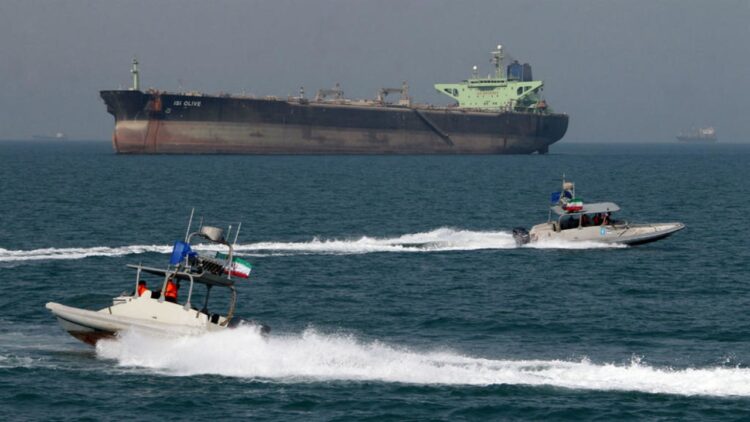
Despite lacking large warships like the United States, Iran has adopted an asymmetric warfare approach in the Strait of Hormuz. The Islamic Revolutionary Guard Corps (IRGC) Navy and the Iranian Navy operate hundreds of fast attack craft (speed boats). Though small in size, these vessels are equipped with machine guns, rocket launchers, and anti-ship missiles.

Swarm Tactics and Disruption Strategy

Iran’s primary objective is to maintain constant pressure on U.S. and international naval forces.

  • Harassment and Disruption: Iranian speed boats frequently interfere with commercial shipping, conducting provocative maneuvers in close proximity to vessels.
  • Swarm Attacks: Multiple small boats operate in coordinated groups to surround and overwhelm larger warships. This forces adversaries to rely on defensive firepower and electronic warfare systems.

Such tactics aim not only to inflict physical damage but also to create psychological pressure and disrupt global economic stability.

Naval Warfare and the ‘Choke Point’ Strategy in Hormuz

The Strait of Hormuz is one of the world’s most critical maritime choke points, through which nearly 20% of global oil and gas supplies pass.

A choke point is a narrow maritime passage that handles a large volume of shipping traffic but can be easily blocked or disrupted. Much like a narrow bridge or tunnel on land, any disruption in such a route can halt global movement and force ships to take long, costly detours.

The Strait of Hormuz, only about 21 miles wide, is vital for global energy flows. In the current crisis:

  • Several oil tankers have been damaged.
  • Insurance costs for shipping have surged.
  • Commercial vessels face delays and rerouting.

Control over such a choke point effectively means controlling a critical lifeline of the global economy.

Iran’s Strategic Use of the Choke Point

Iran’s geographical position along the Strait gives it a strategic advantage. Whenever subjected to sanctions or military pressure by the United States or Western nations, Iran threatens to block the Strait of Hormuz.

Choke points can be used as strategic weapons to:

  • Disrupt global trade and energy supplies
  • Attract international attention and exert pressure
  • Block supply chains of adversaries, including fuel, food, and military resources

In essence, choke points act as maritime “strangleholds”—whoever controls them can significantly influence global economics and warfare outcomes.

Weapons and Tactical Tools Used by Iran

  • Fast Attack Boats and Suicide Drones: Used to swarm and threaten larger vessels
  • Coastal Missile Systems: Land-based anti-ship missiles targeting vessels in transit
  • Smart Sea Mines: Deployed in shipping lanes to create high-risk zones for commercial traffic

Global Impact of Iran’s Strategy

In the current conflict, Iran has carried out multiple low- and high-intensity attacks on commercial vessels. Iranian speed boats and drones often circle dangerously close to oil tankers, creating a climate of fear.

As a result:

  • Global oil prices have surged
  • Shipping companies have altered maritime routes
  • Economic and political pressure has increased worldwide

Even temporary disruptions in this region have far-reaching global consequences.

Future of Naval Warfare: Key Takeaways

The situation in the Strait of Hormuz clearly indicates that future naval warfare will increasingly revolve around:

  • Choke point blockades
  • Drone and swarm-based maritime warfare
  • Asymmetric tactics against conventional naval superiority

Iran’s use of speed boats and low-cost technologies demonstrates how smaller forces can challenge even the most advanced navies.

Human Factor and Importance of National Resilience

This conflict once again underscores that beyond advanced weapon systems, the most decisive factor in war remains the soldier—his training, morale, and fighting spirit.

Equally important is the role of civilians during wartime. In situations involving energy crises or shortages of essential commodities:

  • Citizens must conserve fuel and resources
  • Avoid panic and misinformation
  • Cooperate with government authorities

In future multi-dimensional warfare, disciplined and resilient citizens will play a crucial role in ensuring national strength and ultimate victory.

Total
0
Shares
Share 0
Tweet 0
Pin it 0
Share 0
Share 0

Leave a Reply Cancel reply

Your email address will not be published. Required fields are marked *

Recent Posts

Book Review, Great Maratha General: Mahadaji Scindia – By Brig Hemant Mahajan,YSM

Book Review, Great Maratha General: Mahadaji Scindia – By Brig Hemant Mahajan,YSM

May 12, 2026
BREAKING GLASS CEILING – Col Vijaykant Chenji (Retd)

BREAKING GLASS CEILING – Col Vijaykant Chenji (Retd)

April 21, 2026
Lessons For India: Learning From USA-Iran War – by Brigadier Hemant Mahajan (Retd)

Lessons For India: Learning From USA-Iran War – by Brigadier Hemant Mahajan (Retd)

April 21, 2026
WAR WITHOUT FRONTIERS : How Modern Conflict is Redefining Victory  – by Col Vijay Chenji (Retd)

WAR WITHOUT FRONTIERS : How Modern Conflict is Redefining Victory – by Col Vijay Chenji (Retd)

April 5, 2026
Naval Confrontation in the Strait of Hormuz: American Aircraft Carriers vs Iran’s ‘Choke-Point’ Strategy – by Brigadier Hemant Mahajan

Naval Confrontation in the Strait of Hormuz: American Aircraft Carriers vs Iran’s ‘Choke-Point’ Strategy – by Brigadier Hemant Mahajan

April 4, 2026
From NATO to a New Security Structure in Europe – By C.M.A.Nayar

From NATO to a New Security Structure in Europe – By C.M.A.Nayar

March 31, 2026

<strong>About IIRF</strong>

Indus International Research Foundation is a New Delhi based organisation with its overseas centre at USA . It is part of a global network of scholars, professionals and veterans based in India and abroad. The Foundation focuses primarily on international relations, Indian heritage, political economy and security studies. Led by experts with decades of international and domestic policy experience, IIRF India engages with governments, policymakers, academics, students, industries, practitioners, and civil society to provide insightful and fresh analysis of global trends and India’s challenging role as an emerging world leader. Foundation also runs special programs for veterans.

Office Addresses

Delhi NCR
F-511, Jalvayu Towers, Sector-47, Noida, Gautam Budh Nagar, UP, India – 201301
Email – contact@indusresearch.in
Mobile :- +91 8588021407

USA
India International Research Foundation, 2105 Long Park Avenue Prosper 75078, Dallas, Texas, USA Email – infousa@indusresearch.in

Bangalore
Indus International Research Foundation, Parkside Brigade Orchards, Devanhalli, Bangalore, Karnataka -562110

Explore IIRF

  • Links
  • International Relations & Security
  • History
  • Military Doctrine & Strategy
  • Science and Technology
  • Economics and Commerce
  • Education
  • IIRF Creativity Zone
  • Membership
  • Support IIRF

© 2022 Indus Research

No Result
View All Result
  • Home
  • About
    • Who We Are
    • Patrons
    • Governing Board
    • Advisors
    • Directors
    • Editorial Board
    • Support IIRF
  • Themes
    • International Relations & Security
      • Land Security
      • Maritime Security
      • Aerospace Security
      • Nuclear
      • Geopolitics
    • History
    • Military Doctrine & Strategy
      • Doctrines
      • Joint and Integrated Defence
      • Civil Military Relations
    • Science and Technology
      • Defence Technology
      • Industries and Society
      • Climate Change
      • Natural Resources
    • Economics and Commerce
      • Rare Earth
      • Maritime Economy
      • International Trade
    • Education
  • Focus Geographies
    • South Asian Connectivity & Cooperation
      • Afghanistan
      • Pakistan
      • Nepal
      • Bhutan
      • Bangladesh
      • Myanmar
      • Sri Lanka
      • Maldives
      • BIMSTEC
      • SAARC
      • SAGQ
      • BBIN
      • BRI
      • INSTC
      • IORA
      • MGC
      • IMT
    • Indo-Pacific
      • Indo-Pacific Economic Forum
      • QUAD
      • Oceania
      • IORA
      • Middle East
    • Indo-US Relations
    • Central Asia and Russia
  • Publications
    • Commentary
    • Issue Briefs
    • Research Paper
    • Monograph
    • Journal Articles
    • Books
    • Book reviews
    • Contributors
    • Submission Rules
    • IIRF Strategic Year Book – 2022-23
    • IIRF Strategic Yearbook – 2024
  • Membership
    • Membership Form
  • Indo-US Forum
  • Indian Knowledge System
    • Arts & Culture
    • Yoga & Health
    • Sanskrit Vedic Science Spirituality
  • IIRF Creativity Zone
  • Contact
  • Events & Media
    • IIRF EVENTS
    • US-India Business Connect 2025
    • WTC Utah’s India Trade Mission 2024 Gallery
    • Videos
  • language
    • Hindi

© 2022 Indus Research