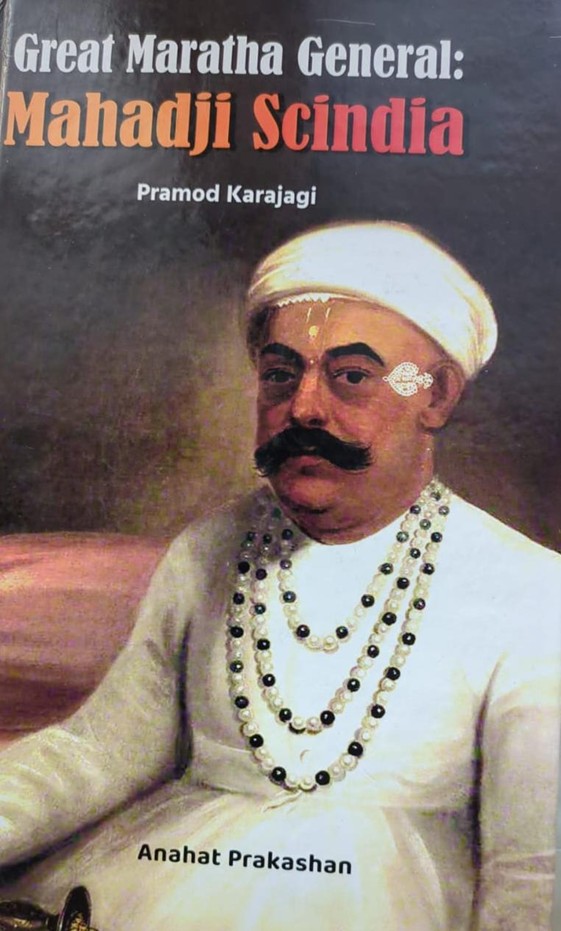
Book Review
Great Maratha General : Mahadaji Scindia
Author : Pramod Karajagi,Publisher: Anahat Prakashan, Pune
Reviewer ; Brig Hemant Mahajan,YSM
Introduction
The eighteenth century occupies a unique and transformative place in Indian history. It was an era of political upheaval, military realignment, imperial decline, and the emergence of new regional powers. Among all the forces that shaped this century, the Marathas stood out as the most dynamic and influential power. From the rugged hill forts of the Deccan to the plains of North India, the Marathas transformed themselves from a regional resistance movement into a pan-Indian political and military force.
This extraordinary rise began under the visionary leadership of Chhatrapati Shivaji Maharaj, who established the ideal of Swarajya — self-rule founded on courage, efficient administration, military innovation, and civilizational pride. After Shivaji Maharaj’s death, many believed that the Maratha state would collapse under the immense pressure of the Mughal Empire. Emperor Aurangzeb personally descended into the Deccan with the determination to crush the Marathas once and for all. Yet, despite deploying the full might of the Mughal Empire for nearly three decades, Aurangzeb failed.
Sambhaji Maharaj resisted fiercely for nine years before his brutal execution. Rajaram Maharaj continued the struggle for another eleven years under difficult circumstances, shifting bases and sustaining the spirit of resistance. Following his death, Maharani Tarabai emerged as one of the greatest women leaders in Indian history and carried forward the fight with exceptional determination. The twenty-seven-year conflict exhausted the Mughal Empire and transformed the Marathas into hardened warriors who believed they could confront and defeat any imperial power.
The death of Aurangzeb near Ahmednagar in 1707 marked not merely the end of a ruler but the beginning of a new political order in India. The Mughal Empire began to fragment rapidly. Into this vacuum stepped the Marathas, who expanded their influence from Attock in the northwest to Cuttack in the east. By the middle of the eighteenth century, the Marathas had become the dominant power in India.
However, history is never linear. The devastating defeat at the Third Battle of Panipat in 1761 appeared to destroy Maratha supremacy. Thousands of experienced soldiers and commanders perished. The psychological shock was immense. Many historians believed that Panipat permanently crippled Maratha ambitions.
Yet from this catastrophe emerged one of the greatest military and political leaders in Indian history — Mahadaji Scindia. Through strategic vision, military reform, diplomatic brilliance, and unyielding determination, Mahadaji rebuilt Maratha influence in North India and delayed British domination for decades.
Pramod Karajagi’s monumental work, Great Maratha General: Mahadaji Scindia, attempts to restore Mahadaji Scindia to his rightful place in Indian history. The book is not merely a biography; it is a study of leadership, statecraft, military innovation, diplomacy, and geopolitical strategy during one of the most decisive periods in India’s past.
The work is deeply researched, intellectually stimulating, and historically significant. It fills an important gap in Indian historiography by bringing attention to a leader whose contributions have often been overshadowed by colonial narratives and selective historical focus.
The Historical Background: The Rise of Maratha Power
To understand the significance of Mahadaji Scindia, one must first understand the broader historical context in which he operated.
The Mughal Empire in the eighteenth century was a declining power. Internal corruption, administrative over-centralization, regional rebellions, economic decline, and military exhaustion had weakened the empire considerably. The invasions of Nadir Shah from Persia in 1739 and Ahmad Shah Abdali from Afghanistan further shattered Mughal prestige.
The Marathas emerged as the only Indian power capable of filling the vacuum left by Mughal decline. Under the leadership of the Peshwas and various Maratha chiefs, they extended their influence across vast parts of India.
In 1757, the Marathas captured Attock, symbolically extending their power to the northwestern frontier of the Indian subcontinent. Their influence stretched from the banks of the Indus to Odisha. This represented the peak of Maratha expansion.
However, the Third Battle of Panipat in 1761 brought disaster. The Marathas suffered terrible losses in men, leadership, and morale. Many contemporary observers believed that Maratha power would never recover.
This is where the story of Mahadaji Scindia becomes extraordinary.
Mahadaji Scindia: The Man Who Rebuilt Maratha Power
Mahadaji Scindia emerged from the ashes of Panipat as one of the principal architects of Maratha resurgence. He survived the battle despite severe injuries and devoted the remainder of his life to restoring Maratha prestige.
He was not simply a battlefield commander. He was a nation-builder, diplomat, administrator, strategist, military reformer, and geopolitical thinker. He understood that the future conflicts in India would not merely be decided by courage but also by organization, logistics, discipline, diplomacy, and modernization.
Pramod Karajagi successfully portrays Mahadaji as a multidimensional personality. The book presents him as a leader who combined traditional Maratha strengths with modern military methods.
One of the greatest strengths of the book is that it does not romanticize Mahadaji blindly. Instead, it places him within the difficult political realities of eighteenth-century India. The Maratha Confederacy itself was divided by internal rivalries. Regional chiefs competed for influence. External enemies constantly attempted to exploit divisions.
Mahadaji’s achievement, therefore, was not merely military victory but political stabilization.
About the Author: Pramod Karajagi and His Contribution
A special mention must be made of the author, Pramod Karajagi, whose dedication to historical research deserves immense appreciation.
Karajagi has spent nearly fifteen years researching the life, campaigns, correspondence, and political legacy of Mahadaji Scindia. Such long-term commitment to historical scholarship is rare in contemporary times, especially in the field of Indian military history where serious archival research often remains neglected.
One of the author’s greatest contributions is his effort to bring Mahadaji Scindia into mainstream historical discussion. Indian historiography has frequently focused either on Mughal rulers or on the British colonial narrative. Many outstanding Indian military and political leaders of the eighteenth century have not received the recognition they deserve.
Karajagi attempts to correct this imbalance.
The author draws from official records, letters, diplomatic correspondence, military accounts, and historical analyses to reconstruct the life and times of Mahadaji Scindia. His writing reflects both passion and discipline. He combines narrative storytelling with detailed analysis, making the book accessible to general readers while also retaining scholarly value.
Another major contribution of the author is his decision to write the book in English. This is strategically important. Much of the literature on Maratha history exists in Marathi, limiting its reach to a regional audience. By writing in English, Karajagi has ensured that Mahadaji Scindia’s achievements become accessible to readers across India and abroad.
The author also contributes significantly to military studies. His detailed examination of battlefield tactics, logistics, force structures, cavalry operations, and diplomacy makes the book useful not only for historians but also for students of strategic studies and military leadership.
Perhaps most importantly, Karajagi restores historical dignity to a leader who played a decisive role in resisting early British expansion.
Mahadaji Scindia and Nana Fadnavis: Twin Pillars of Maratha Revival
The book correctly highlights the complementary roles of Mahadaji Scindia and Nana Fadnavis.
If Mahadaji represented military strength and strategic assertiveness, Nana Fadnavis represented diplomatic finesse and administrative stability.
The eighteenth century was an era of shifting alliances. The British, French, Mysore rulers, Nizam, Rajputs, Sikhs, Rohillas, and Afghan invaders constantly altered the political balance. Managing these relationships required exceptional political skill.
Mahadaji and Nana Fadnavis occasionally differed in their methods and ambitions, yet both recognized that Maratha unity and survival were more important than personal rivalry.
Karajagi effectively demonstrates how the combination of military power and diplomatic statecraft allowed the Marathas to recover after Panipat.
Diplomatic Brilliance of Mahadaji Scindia
One of the most impressive aspects of Mahadaji Scindia’s personality was his diplomatic capability.
He understood that military victories alone could not sustain an empire. Alliances, negotiations, political balancing, and strategic compromise were equally important.
Mahadaji successfully dealt with:
- The Mughal court
- Rajput rulers
- Jat chiefs
- Rohilla leaders
- British representatives
- French military advisers
- Rival Maratha factions
His diplomacy was pragmatic rather than emotional. He recognized when to fight and when to negotiate.
The book offers several examples of Mahadaji’s ability to convert military advantage into political leverage. His peace settlements and negotiations often ensured long-term strategic benefits.
A particularly noteworthy achievement was his restoration of Mughal authority in Delhi under Maratha influence. By positioning himself as protector of the Mughal Emperor, Mahadaji gained legitimacy and political influence throughout North India.
Karajagi presents Mahadaji as a master strategist who understood perception, symbolism, and political psychology.
Military Genius and Battlefield Innovation
The military sections of the book are among its strongest features.
Mahadaji Scindia fought more than forty battles during his lifetime against a wide range of adversaries including the British, Rajputs, Jats, Rohillas, Mughals, and rival Maratha chiefs.
The author explains in detail how Mahadaji blended traditional Maratha mobility with European military methods.
Traditional Maratha warfare emphasized:
- Rapid cavalry movement
- Surprise attacks
- Guerrilla tactics
- Flexible operations
- Deep penetration raids
- Harassment of supply lines
Mahadaji retained these strengths while incorporating:
- European-style infantry drills
- Modern artillery deployment
- Structured command systems
- Improved logistics
- Professional military training
This hybrid military model gave his forces significant operational flexibility.
Karajagi particularly emphasizes Mahadaji’s understanding of mobility. Fast-moving cavalry allowed the Marathas to strike unexpectedly, disrupt enemy communication, and avoid prolonged attritional warfare.
The book also discusses the importance Mahadaji placed on intelligence gathering. Spies, informants, and local collaborators played a critical role in his campaigns.
His use of deception and psychological warfare reflects remarkable strategic sophistication.
In many ways, Mahadaji anticipated several principles associated with modern maneuver warfare.
The Battle of Talegaon and Tactical Evolution
One of the most important military analyses in the book concerns the Battle of Talegaon.
Karajagi presents this battle as a turning point in Mahadaji’s tactical evolution. The campaign demonstrated the effectiveness of mobility, intelligence, supply disruption, and coordinated operations.
The Marathas exploited terrain, mobility, and local support to wear down British forces.
Rather than engaging in rigid frontal combat, Mahadaji preferred flexible operational methods that exhausted the enemy psychologically and logistically.
The book’s detailed explanation of these tactics makes it particularly valuable for military history students.
Comparison Between Maratha and British Military Systems
Another excellent feature of the book is its comparative study of the Maratha and British military systems.
Karajagi examines differences in:
- Marching methods
- Supply chains
- Camp administration
- Communication systems
- Infantry structure
- Cavalry organization
- Discipline standards
- Artillery deployment
Mahadaji carefully studied British strengths and weaknesses.
Unlike many traditional rulers who dismissed European methods, Mahadaji adopted a practical approach. He selectively integrated effective European military techniques without abandoning core Maratha strengths.
This balanced modernization process helped create one of the most formidable armies in eighteenth-century India.
Military Reforms and Organizational Vision
The book provides a detailed account of Mahadaji’s military reforms.
The Maratha armies after Panipat had become fragmented and disorganized. Mahadaji recognized that discipline and organization were essential for long-term success.
He introduced:
- Rigorous recruitment standards
- Structured military training
- Regular drills and exercises
- Improved logistical systems
- Better weapon stockpiles
- Medical support systems
- Welfare provisions for soldiers
- Strict discipline and accountability
These reforms reflected not merely tactical thinking but organizational vision.
Mahadaji also understood the importance of morale. Soldiers who felt valued and supported were more likely to remain loyal and effective.
The book repeatedly highlights his concern for the welfare of wounded soldiers and families of fallen troops.
Economics of Warfare
One of the most intellectually stimulating sections of the book concerns the economics of warfare.
Karajagi examines the financial dimensions of military campaigns and imperial administration.
Under Shivaji Maharaj, military expenditure was tightly controlled and linked to state revenue. However, during later periods, financial discipline weakened.
Continuous campaigns, factional rivalries, and administrative inefficiencies increased debt burdens.
The author raises an important question: could stronger financial management have altered the eventual decline of Maratha power?
This discussion remains highly relevant even in modern strategic studies. Military power without economic sustainability eventually becomes fragile.
The author deserves praise for incorporating financial analysis into military history.
Humanitarian Dimensions of Maratha Warfare
The book also makes an important distinction between Maratha warfare and the destructive invasions carried out by foreign invaders such as Nadir Shah and Ahmad Shah Abdali.
Many eighteenth-century invasions involved:
- Mass slaughter
- Destruction of cities
- Looting of wealth
- Enslavement of civilians
- Religious persecution
Karajagi says that Maratha campaigns generally avoided large-scale destruction of civilian society and religious institutions.
This observation is important because it highlights the ethical and civilizational dimensions of Maratha statecraft.
The book further notes Mahadaji’s efforts to protect soldiers and maintain discipline among troops.
Leadership Qualities of Mahadaji Scindia
The personality analysis of Mahadaji Scindia is another strong element of the book.
Mahadaji possessed:
- Strategic foresight
- Political intelligence
- Personal courage
- Adaptability
- Charisma
- Administrative capability
- Emotional resilience
He inspired loyalty among officers from diverse backgrounds including Marathas, North Indians, and Europeans.
One of his greatest strengths was talent recognition. He selected capable subordinates and trusted them with responsibility.
The book effectively portrays him not as an isolated hero but as a leader capable of building teams and institutions.
This leadership dimension makes the work highly relevant for modern readers, including military officers, administrators, and management professionals.
Mahadaji Scindia and Resistance to British Expansion
One of the most significant historical arguments advanced by the book is that Mahadaji Scindia delayed British domination of India by several decades.
This is an important point.
British expansion in India was not inevitable. It succeeded gradually by exploiting:
- Internal divisions
- Weak regional leadership
- Financial instability
- Military disorganization
- Diplomatic fragmentation
Mahadaji recognized the long-term threat posed by the British East India Company earlier than many of his contemporaries.
His modernization efforts, diplomatic balancing, and military campaigns slowed British penetration into North India.
Karajagi correctly presents Mahadaji as one of the earliest Indian leaders to systematically resist European political expansion.
The Book as a Contribution to Indian Military History
Indian military history remains underdeveloped compared to Western scholarship.
Many Indian military leaders are either romanticized superficially or neglected entirely.
This book contributes significantly to correcting that imbalance.
Karajagi’s detailed discussion of:
- Logistics
- Intelligence
- Cavalry operations
- Combined arms tactics
- Force restructuring
- Diplomacy
- War finance
- Leadership
makes the book especially valuable for students of strategic studies.
The work demonstrates that Indian military traditions possessed sophistication, adaptability, and strategic depth.
Strong Points of the Book
The book possesses several outstanding strengths.
- Extensive Research
The depth of archival and historical research is impressive. The author’s fifteen-year effort is clearly visible throughout the book.
- Restoration of Historical Balance
The work restores attention to an overlooked Indian statesman and military leader.
- Excellent Military Analysis
The discussion of tactics, reforms, logistics, and strategy is highly valuable.
- Readability
Despite covering complex historical material, the writing remains accessible and engaging.
- Integration of Diplomacy and Warfare
The author successfully shows that military success depends on political and diplomatic strategy.
- Relevance for Modern Strategic Studies
The lessons regarding leadership, logistics, modernization, and statecraft remain relevant today.
- Balanced Portrayal
The author avoids simplistic hero worship and presents Mahadaji within broader political realities.
- Contribution to National Historical Awareness
The book strengthens understanding of indigenous Indian strategic traditions.
Few Weak Points of the Book
While the book is highly impressive, certain limitations may also be noted.
- Density of Information
At times, the amount of military and political detail becomes overwhelming for casual readers.Certain chapters could have benefited from more concise structuring.
- Need for More Maps and Visual Aids
Given the complexity of military campaigns, additional maps, battle diagrams, and organizational charts would have improved readability.
- Limited Comparative Perspective
The book occasionally could have benefited from broader comparison with contemporary global military developments.
- Editing and Structural Improvements
Certain sections could benefit from tighter editing, smoother transitions, and clearer chapter organization. However, these limitations do not significantly reduce the overall importance or quality of the work.
Lessons for Modern India
One of the remarkable aspects of this book is its contemporary relevance.
Mahadaji Scindia’s life offers important lessons for modern India in several domains.
Strategic Vision
He understood long-term geopolitical threats and adapted accordingly.
Indigenous Modernization
He modernized military systems without abandoning indigenous strengths.
National Unity
He recognized the dangers of internal divisions.
Importance of Logistics
His campaigns demonstrated that logistics and supply systems are as important as battlefield courage.
Diplomacy and Hard Power
He combined negotiation with military capability.
Leadership Through Resilience
After surviving Panipat, he rebuilt power through persistence and strategic patience.
These lessons remain relevant in today’s strategic environment.
Why Mahadaji Scindia Matters Today
Modern India often remembers the great figures of ancient and medieval history but pays less attention to the complex strategic leaders of the eighteenth century.
Mahadaji Scindia deserves far greater national recognition because:
- He rebuilt Indian power after catastrophic defeat.
- He resisted colonial expansion.
- He modernized indigenous military systems.
- He demonstrated exceptional strategic flexibility.
- He combined diplomacy with warfare.
- He restored Maratha influence across North India.
In many ways, Mahadaji represented the last major Indian statesman who seriously attempted to create a unified indigenous power structure before British dominance became overwhelming.
The Importance of Writing Indian History from an Indian Perspective
Another significant contribution of the book is its attempt to narrate Indian history from an Indian perspective.
Colonial historiography often portrayed Indian powers as chaotic, backward, or incapable of strategic thought.
Karajagi’s work challenges these assumptions.
The book demonstrates that eighteenth-century Indian leaders possessed:
- Strategic sophistication
- Diplomatic capability
- Military innovation
- Administrative intelligence
- Geopolitical awareness
This corrective perspective is important for building balanced historical understanding.
Conclusion
Great Maratha General: Mahadaji Scindia by Pramod Karajagi is an outstanding contribution to Indian historical and military literature.
It is far more than a biography. It is a comprehensive exploration of leadership, warfare, diplomacy, statecraft, modernization, and national resilience during one of the most turbulent periods in Indian history.
The book succeeds in restoring Mahadaji Scindia to his rightful place among the greatest Indian military and political leaders. Through detailed research and thoughtful analysis, the author demonstrates how Mahadaji rebuilt Maratha authority after Panipat, modernized military systems, resisted British expansion, and shaped the political destiny of eighteenth-century India.
Pramod Karajagi deserves immense appreciation for his dedication, scholarship, and commitment to preserving an important chapter of Indian history.
The work is especially valuable for:
- Historians
- Military professionals
- Students of strategic studies
- Political analysts
- Leadership scholars
- Readers interested in Maratha history
At a time when India is increasingly rediscovering its civilizational and strategic heritage, books such as this play an essential role.
Mahadaji Scindia’s life is ultimately a story of resilience after defeat, strategic adaptation in changing times, and unwavering commitment to national power.
His legacy remains a powerful reminder that determined leadership, organizational reform, strategic clarity, and national unity can revive even a seemingly shattered state.
For readers seeking to understand the real architects of Indian power in the eighteenth century, this book is not merely recommended reading — it is essential reading.
Brig Hemant Mahajan, YSM
Defence Analyst | Military Veteran | Author | National Security Expert
Brig Hemant Mahajan, Yudh Seva Medal (Gallantry), is a distinguished Indian Army veteran, defence analyst, and prolific author with extensive operational, instructional, and academic experience in national security.
During his illustrious military career, he commanded the 7 Maratha Light Infantry in Operation Rakshak in the highly challenging insurgency-affected areas of Poonch and Rajouri (Jammu & Kashmir). Under his leadership, the unit displayed exceptional operational effectiveness and was awarded a Unit Citation, along with 18 gallantry awards, including the Yudh Seva Medal (Gallantry) awarded to him.
He also served during Operation Parakram, where his outstanding dedication and professional excellence earned him the Army Commander’s Commendation.
Brig Mahajan later commanded an Infantry Brigade in Operation Rakshak, operating in some of the most intense counter-insurgency zones, including Poonch, Krishna Ghati, Surankot, and Rajouri. His brigade achieved remarkable success: one unit received a Unit Citation, a BSF battalion under command was adjudged the best battalion in the country, and an officer from the brigade received the highest gallantry award of the year (2006).
In February 2006, he joined the Higher Command Wing, Army War College as Directing Staff (DS), mentoring senior officers and contributing to higher military education.
Brig Mahajan has authored over 5,500 published articles and 17 books on national security, covering military strategy, internal security, and geopolitics.
He also served as the Chair Professor, Swatantra Veer Savarkar Chair for National Security at Savitribai Phule Pune University from 2018 to 2021.