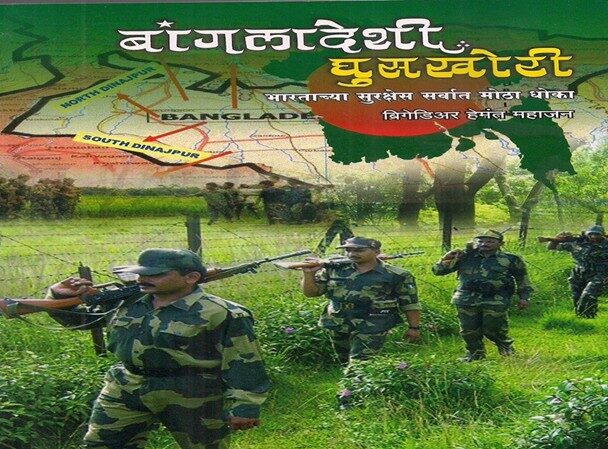
“Infiltration is a Major Challenge”
Union Home Minister Amit Shah announced on 26 May 2026 that the Government of India has constituted a high-level committee to examine the “demographic changes taking place in the country due to illegal infiltration and other unnatural causes.”
“Unnatural demographic changes caused by infiltration pose a very serious challenge to the present and future of any nation.”
The committee will be chaired by retired Justice Prakash Prabhakar Naolekar. Its members will include the Census Commissioner, former IAS officer Durga Shankar Mishra, former IPS officer Balaji Srivastava, and economist Dr. Shamika Ravi. The Joint Secretary (Foreigners-I) in the Ministry of Home Affairs will function as the Member Secretary of the committee.
The committee will undertake a comprehensive assessment of demographic changes occurring across India due to illegal migration” It will also recommend “structured and time-bound measures” to address the issue.
Shah described demographic change as a “serious matter” that affects the country’s social structure and the protection of tribal communities.
Prime Minister Narendra Modi had earlier stated that “infiltrators are creating a new crisis for the nation. Linking demographic change with national security and social stability, the Prime Minister further stated that “no nation in the world can surrender itself to infiltrators.”
West Bengal Became the Main Gateway of Bangladeshi Infiltration
During the tenure of the Mamata Banerjee government, West Bengal emerged as one of the principal gateways for illegal Bangladeshi infiltration into India. However, after political changes and increasing focus on national security, extensive campaigns have now been launched to strengthen border security and take stricter action against illegal Bangladeshi infiltrators.
The focus is no longer limited to preventing fresh infiltration. Authorities have also begun large-scale efforts to identify and act against illegal Bangladeshi nationals already residing secretly within India. There is now growing hope that the number of illegal infiltrators in India may gradually decline in the coming years.
Illegal Bangladeshi infiltration has had far-reaching implications for India’s national security, social stability, demographic balance, electoral system, and organized crime networks. Following the creation of Bangladesh, large-scale migration that began, and over the decades has gradually evolved into organized infiltration networks.
Migration Expanded to Major Metropolitan Cities
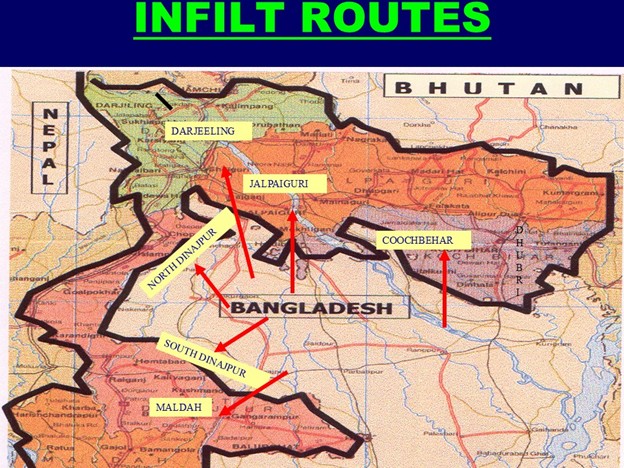
The India-Bangladesh border is extremely complex. Large stretches include rivers, marshlands, forests, agricultural regions, and densely populated settlements, making complete border security extremely difficult.
Taking advantage of these geographical conditions, human trafficking networks developed extensive infiltration routes. Economic hardship, unemployment, population pressure in Bangladesh, and employment opportunities in India encouraged many Bangladeshi citizens to enter India illegally.
Over time, this migration was no longer confined to border states. It spread into many states and major Indian metropolitan centers such as Mumbai, Pune, Delhi, Hyderabad, and Bengaluru.
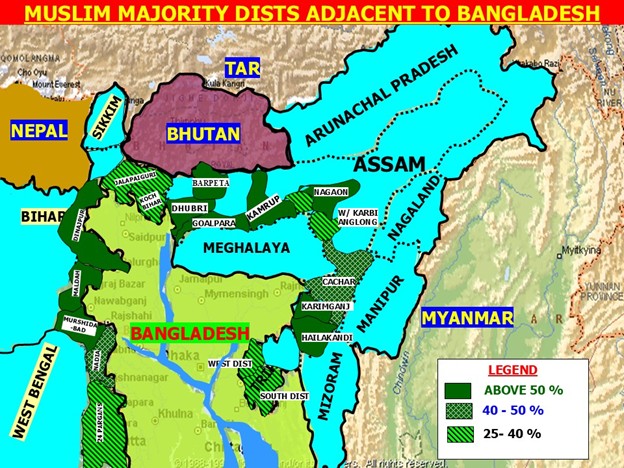 For a long period, the issue was often viewed through the prism of politics and vote-bank calculations rather than as a serious national security threat. In certain areas, illegal migrants allegedly received political protection because they were viewed as future vote banks.
The Border Security Force has often been criticized for failing to stop infiltration across the Bangladesh border. The required institutional willpower and operational capability necessary for comprehensive border management have not always been visible.
In many places, fake Aadhaar cards, voter identity cards, ration cards, and other forged documents became easily available. This enabled illegal infiltrators to settle more permanently within India.
Border Fencing Work Accelerated
However, in recent years, significant changes have become visible. The central government has begun treating border security as an extremely important component of national security and has initiated several strict measures.
Particularly in West Bengal, large tracts of land have been transferred to the Border Security Force for border protection infrastructure. Fencing work across nearly 300 to 400 kilometers of border areas is expected to accelerate rapidly.
Previously, land disputes, local resistance, and political obstacles had delayed such projects. Now, however, double-layer fencing, floodlights, border roads, observation towers, and modern electronic sensors are being deployed to strengthen border management.
Simultaneously, the Border Security Force should significantly increase night patrols, riverine patrols, drone surveillance, thermal imaging, and smart surveillance systems.This will improve monitoring and control over infiltration routes.
Campaign Against Illegal Settlements
Another major development in West Bengal has been the campaign to remove illegal settlements.
For many years, illegal Bangladeshi settlers occupied government land, railway property, forest areas, and slum regions. Authorities are now identifying such settlements and taking steps to dismantle them.
This campaign is considered important because once large illegal settlements become established, they eventually evolve into politically and socially sensitive zones, making future action difficult.
At the same time, large-scale document verification drives have been launched. Police and intelligence agencies are scrutinizing fake Aadhaar cards, voter cards, birth certificates, and ration cards.
Action has also been taken against criminal gangs involved in manufacturing forged documents. This is particularly significant because fake identity documentation forms the backbone of illegal migration networks.
Efforts are also underway to establish dedicated detention centers or temporary holding facilities for detained Bangladeshi nationals. Earlier, many arrested infiltrators disappeared due to weaknesses in the legal process and inadequate detention arrangements. Authorities are now increasingly relying on biometric registration systems to ensure more effective deportation procedures.
 Large-Scale Action in Maharashtra
Large-scale operations have also begun in Maharashtra.
Although Maharashtra does not share a border with Bangladesh, its major cities provide vast employment opportunities. As a result, many Bangladeshi nationals attempted to settle there illegally.
Cities such as Mumbai and Pune witnessed the growth of illegal migrant networks due to high demand for low-cost labor in construction, small industries, hotels, transportation ,and domestic work sectors.
The Maharashtra Police have now launched extensive verification drives in slums, construction sites, labor colonies, and rented accommodations.
Action is also being taken against gangs involved in preparing fake Aadhaar cards, PAN cards, and voter identity documents.
Additionally, authorities should start using biometric data collection,facial recognition systems, and centralized databases
to prevent repeat infiltration.
Links with Organized Crime and Security Threats
Illegal migration routes are often exploited not only for infiltration but also for human trafficking, narcotics smuggling, counterfeit currency operations and terrorist logistics networks.
Demographic changes in border districts have also created social tensions in certain regions.
Some extremist organizations are believed to use illegal networks for logistical support and covert operations.
Major Challenges Still Remain
Despite current efforts, many major challenges continue to exist.
Complete fencing of the entire border is still unfinished. Riverine border management requires further strengthening. Coordination between central and state governments must improve significantly.
India also urgently requires a centralized national database of illegal foreign nationals.
Beyond this, strict action must be taken against the entire ecosystem that facilitates illegal migration. This includes document forgers, corrupt officials,
human traffickers, and employers who hire workers without verification.
Mandatory police verification of all tenants and workers may also become necessary.
India must further expand the use of artificial intelligence, drones, satellite surveillance, smart fencing, and advanced monitoring systems for border security management.
At the diplomatic level, sustained engagement with Bangladesh will remain essential to ensure faster deportation mechanisms and coordinated border patrols.
A Long-Term National Security Challenge
Illegal Bangladeshi infiltration represents one of the most sensitive and long-term national security challenges facing India.
However, the measures currently being implemented indicate that India is now approaching the issue with far greater seriousness and from a national security perspective.
If these measures are implemented consistently and firmly over the long term, it may become possible to significantly control illegal infiltration in the future.
Additional Measures That May Be Required
In major cities where large numbers of illegal Bangladeshi infiltrators are believed to reside, each police station should have 65 to 75 dedicated Investigation Officers (IOs). Retired police personnel across the country could be effectively utilized for this purpose.
Special joint task forces should be formed consisting of investigation officers,
intelligence personnel, Bengali language experts, and local citizens familiar with regional conditions.
Fast-track courts or special tribunals should be established so that related cases can be resolved within seven to ten days.
To reduce the burden on police forces, in-camera trial mechanisms should be introduced, and provisions for granting bail to illegal infiltrators may need reconsideration.
All detained illegal migrants should be housed in special camps while legal proceedings are underway.
Search operations, arrests, and deportation-related activities should be conducted with a high degree of operational secrecy. Unnecessary media publicity and excessive public disclosure should be avoided.
Conclusion
Illegal Bangladeshi infiltration remains a massive and long-term national challenge for India. Estimates in some discussions suggest that several crores of illegal Bangladeshi nationals may still be residing in India unlawfully. Identifying them, processing them, and deporting them represents an enormous national undertaking.
Successfully addressing this issue will require sustained coordination among:
- the central government,
- state governments,
- police forces,
- intelligence agencies,
- the Border Security Force,
- local administration,
- and ordinary citizens.
Only through long-term, consistent, and coordinated efforts involving stronger border security, dismantling fake document networks, removing illegal settlements, implementing biometric registration, and taking strict action against illegal employment ecosystems can India hope to achieve decisive control over this serious national security challenge.