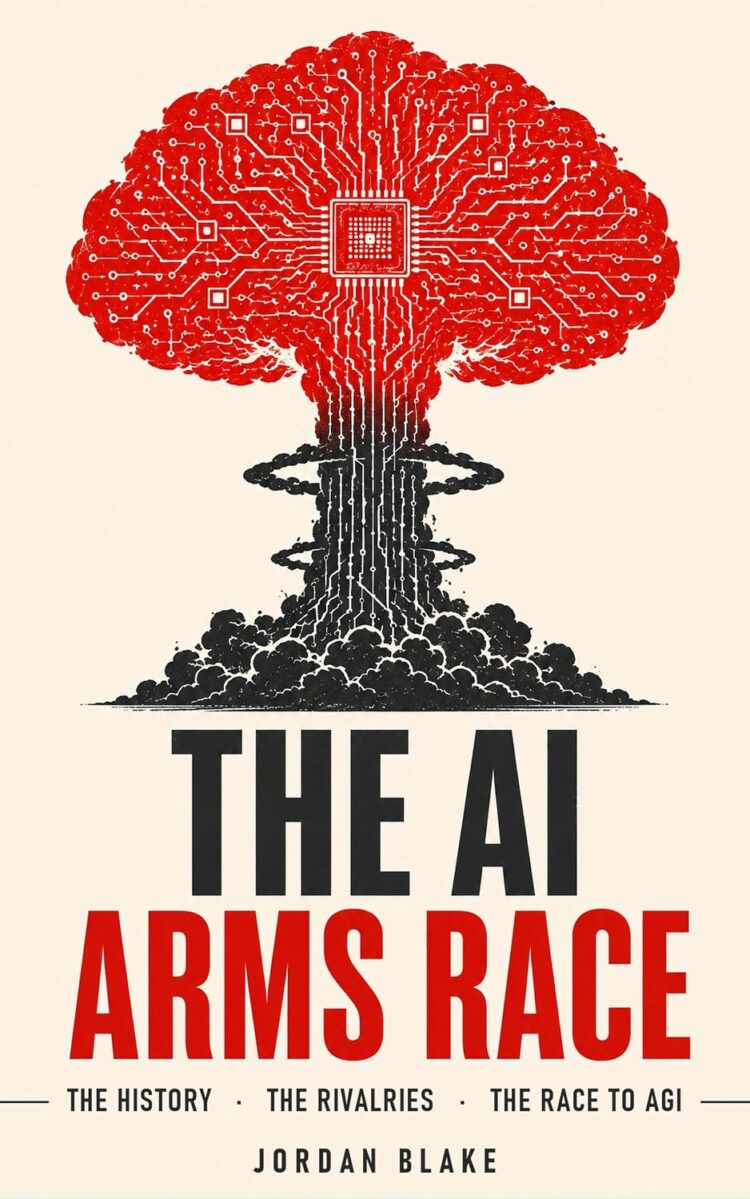
Book Title: The AI Arms Race: From ChatGPT and Claude to Gemini and Grok — The History, Rivalries, and Race to Build Artificial General Intelligence
Author: Jordan Blake
Print Length: 379 pages (Paperback/Print edition)
Publication Date: June 26, 2026
Overview: The book chronicles the high-stakes business and philosophical rivalries between major AI labs—including OpenAI, Anthropic, Google, and xAI—detailing events like the OpenAI leadership coup and the push toward artificial general intelligence (AGI).
Formats Available: Kindle, Audiobook, Hardcover, and Paperback.
Introduction
The history of humanity has often been shaped by races. Nations raced to discover new continents. Empires raced to build larger armies and navies. The United States and the Soviet Union raced to conquer space and develop nuclear weapons. Every great technological revolution has produced winners and losers, transformed economies, and reshaped the global balance of power.
Today, another race is underway.
It is not being fought with tanks, warships, or missiles. The battlefields are research laboratories, data centers, semiconductor factories, and corporate boardrooms. The competitors are not governments alone, but technology giants, visionary entrepreneurs, scientists, investors, and increasingly, entire nations.
At stake is something unprecedented: the creation of Artificial General Intelligence (AGI), a form of artificial intelligence capable of matching or surpassing human intelligence across virtually every intellectual task.
This is the world explored in Jordan Blake’s fascinating book, The AI Arms Race: From ChatGPT and Claude to Gemini and Grok — The History, Rivalries, and Race to Build Artificial General Intelligence. The book presents one of the most accessible and compelling narratives of the greatest technological competition of the twenty-first century. Rather than overwhelming readers with mathematical formulas and computer science terminology, Blake tells a human story filled with ambition, rivalry, innovation, drama, and uncertainty.
The result is a work that reads partly like a business thriller, partly like a geopolitical study, and partly like a glimpse into humanity’s future.
The Moment the World Changed
For many decades, artificial intelligence remained largely confined to universities, research laboratories, and science fiction. Scientists spoke about machine intelligence, but most ordinary people had little interaction with it. Voice assistants existed, search engines had become sophisticated, and recommendation algorithms quietly influenced daily life, yet AI remained largely invisible.
That changed dramatically on November 30, 2022.
On that day, OpenAI released ChatGPT to the public. What appeared initially to be a simple chatbot quickly became a global phenomenon. Millions of users were astonished to discover that a machine could write essays, answer questions, create stories, summarize research papers, generate computer code, and hold remarkably human-like conversations. Suddenly, artificial intelligence was no longer a laboratory experiment. It had entered homes, classrooms, businesses, and government offices.
Blake presents this moment as the equivalent of the iPhone’s arrival in the world of mobile technology. Just as smartphones transformed communications, ChatGPT transformed public understanding of artificial intelligence.
The launch triggered a realization across the technology industry that a new era had begun. Companies that had previously viewed AI as a long-term research project suddenly recognized it as an immediate strategic necessity. Executives feared being left behind. Investors rushed billions of dollars into AI startups. Governments began discussing regulation. Universities redesigned curricula. Workers wondered whether their jobs were safe.
The race had begun in earnest.
The Men and Women Behind the Machines
One of the greatest strengths of the book is its focus on people rather than machines. Blake understands that technology does not emerge in isolation. Every breakthrough reflects the ambitions, beliefs, and decisions of individuals.
The narrative introduces readers to a cast of remarkable personalities. Entrepreneurs dream of changing the world. Scientists pursue breakthroughs that once seemed impossible. Investors place billion-dollar wagers on uncertain futures. Corporate leaders compete to dominate emerging markets.
These individuals are not simply designing software. They are shaping the future architecture of global society.
Throughout the book, Blake repeatedly returns to one central question:
Who should be trusted with the power to create a machine potentially more intelligent than any human being?
It is a question with no easy answer.
The OpenAI Revolution
At the center of the story stands OpenAI.
Founded with the ambitious goal of ensuring that artificial intelligence benefits humanity, OpenAI became the organization most closely associated with the modern AI revolution. The company moved rapidly from a research-focused institution to a global technology powerhouse.
The book chronicles OpenAI’s astonishing journey from an idealistic startup to one of the most influential organizations in the world. Its partnership with Microsoft provided enormous computing resources and financial backing, allowing the company to accelerate development of increasingly powerful AI models.
Yet success brought new challenges.
As OpenAI grew more influential, debates emerged concerning safety, governance, commercialization, and the pace of AI development. These tensions eventually erupted into one of the most extraordinary corporate dramas in modern business history.
The Four-Day Coup
Perhaps the most dramatic section of the book concerns what became known as the “four-day coup” at OpenAI.
Blake reconstructs a remarkable sequence of events that stunned the technology world. In a move that appeared almost unimaginable, OpenAI’s board removed its most prominent leader. The decision triggered chaos inside the company. Employees revolted. Investors became alarmed. Partners questioned the organization’s future. Within days, the very existence of OpenAI seemed uncertain.
Yet just as rapidly, events changed direction.
The dismissed leader returned, the board was reshaped, and OpenAI emerged from the crisis stronger and more influential than before.
For Blake, this episode represents far more than corporate intrigue. It highlights the enormous stakes associated with artificial intelligence. Decisions made by a handful of individuals inside one company can have implications affecting governments, industries, and billions of people worldwide.
The lesson is clear: in the age of AI, governance matters as much as innovation.
The Birth of Anthropic and Claude
Every great technological revolution produces competing visions.
While OpenAI pursued rapid innovation and broad deployment, another group of researchers believed a more cautious approach was necessary. Their concerns focused on safety, alignment, and the risks associated with increasingly powerful AI systems.
These concerns helped give birth to Anthropic and its AI system, Claude.
Blake presents Anthropic not simply as a competitor but as a philosophical alternative. The company’s founders believe that advanced AI must be developed carefully, with extensive attention to safety and reliability.
The rivalry between OpenAI and Anthropic therefore extends beyond market competition. It represents competing beliefs about how humanity should approach one of the most transformative technologies ever invented.
Should innovators move as quickly as possible to unlock AI’s potential?
Or should society proceed more cautiously to minimize unforeseen risks?
The debate continues today and remains one of the defining questions of the AI age.
Google’s Awakening
For years, Google appeared to be the undisputed leader in artificial intelligence research. Its scientists had produced many of the breakthroughs that made modern AI possible. Through DeepMind and other research divisions, Google possessed unparalleled technical expertise.
Yet the arrival of ChatGPT created a profound shock inside the company.
The book vividly describes how Google’s leadership suddenly realized that its dominance in online search could be threatened. Internal alarms sounded. Strategic reviews were launched. Executives declared what became known as a “Code Red” response.
Google understood that AI-powered conversational systems could fundamentally change how people access information. Instead of typing search queries and reviewing links, users might increasingly interact directly with intelligent assistants.
Such a shift threatened the foundation of Google’s business model.
The company’s response was Gemini, an ambitious effort to regain momentum in the rapidly evolving AI landscape.
Blake portrays Google’s reaction as the story of a giant awakening after realizing that technological leadership can never be taken for granted.
Elon Musk Enters the Battlefield
No modern technology story would be complete without Elon Musk.
Having played an early role in OpenAI’s creation, Musk eventually became one of its most vocal critics. Concerned about the direction of AI development, he launched his own company, xAI, and introduced Grok as a competitor in the increasingly crowded marketplace.
Blake’s portrayal of Musk highlights both his strengths and controversies. Admirers view him as a visionary willing to challenge established assumptions. Critics regard him as unpredictable and disruptive.
Regardless of perspective, few doubt his influence.
The emergence of Grok added another powerful player to the AI race while reinforcing a broader reality: the future of artificial intelligence will likely be shaped not by a single company but by multiple competing ecosystems.
The Invisible War Over Chips
Perhaps the most important contribution of the book is its emphasis on a subject often overlooked by the general public: semiconductors.
Most discussions of artificial intelligence focus on software, algorithms, and chatbots. Blake reminds readers that none of these innovations can exist without advanced computer chips.
Every AI model depends upon enormous computational power. Training large language models requires vast quantities of specialized processors capable of handling extraordinary workloads. These chips have become the fuel powering the AI revolution.
Consequently, companies such as Nvidia have become strategic giants. Semiconductor manufacturing facilities in Taiwan have acquired immense geopolitical importance. Supply-chain disruptions now carry implications extending far beyond commercial concerns.
The book argues persuasively that future geopolitical tensions may revolve as much around semiconductor access as around oil, natural gas, or strategic minerals.
This observation is especially important for policymakers and national security professionals.
Control over computing infrastructure may ultimately determine who leads the AI age.
The Quest for Artificial General Intelligence
As the narrative progresses, Blake turns toward the ultimate goal driving the world’s leading AI organizations: AGI.
Artificial General Intelligence refers to a system capable of performing intellectual tasks at or above human levels across an extremely broad range of activities.
Unlike today’s AI systems, which often excel within specific domains, AGI would possess far greater flexibility and adaptability.
The prospect is both exciting and unsettling.
Supporters believe AGI could help solve humanity’s greatest problems, including disease, poverty, climate challenges, and scientific discovery.
Skeptics worry about concentration of power, job displacement, misinformation, security risks, and loss of human control.
Rather than promoting extreme optimism or pessimism, Blake provides a balanced discussion of competing viewpoints. He recognizes that predictions about AGI remain uncertain and that even experts disagree regarding timelines and outcomes.
This balanced treatment is among the book’s most admirable qualities.
What the AI Race Means for Ordinary People And Societal Implications
One reason the book resonates with readers is its practical orientation.
Blake consistently translates complex developments into real-world implications. The discussion is not limited to technology executives or research scientists. He addresses students, professionals, entrepreneurs, policymakers, and ordinary citizens.
The emergence of AI raises important questions.
How will careers change?
Which skills will remain valuable?
How should organizations adapt?
How can individuals remain relevant in an age of intelligent machines?
The book’s recurring “Field Notes” sections help readers connect large technological trends to personal and professional decision-making.
A central message emerges:
The future will not belong exclusively to artificial intelligence. It will belong to people who learn how to work effectively alongside artificial intelligence.
AI will not replace all humans, but humans who effectively use AI may replace those who do not.
Critical Review
Strengths
Highly Accessible-One of the greatest strengths of the book is its ability to explain complex topics without overwhelming readers with technical jargon.The author successfully translates complicated concepts such as Neural networks, Scaling laws, AI alignment, AGI into language that business leaders, students, policymakers, and general readers can understand.
Engaging Storytelling-Rather than presenting a technical textbook, Blake structures the narrative around people and rivalries .The book reads like a combination of Business history, Technology analysis, Corporate drama, Geopolitical strategy
Balanced Perspective-The author neither embraces AI utopianism nor promotes AI doom scenarios.This balanced approach significantly enhances the book’s credibility.
Strategic Relevance-For military officers, policymakers, strategic analysts, and national security professionals, the discussion of Semiconductors, Technology competition, U.S.-China rivalry. Supply-chain vulnerabilities is especially valuable.
Weaknesses
Limited Technical Depth-Experts in machine learning may find the explanations too simplified. The book focuses more on strategic implications than on technical architecture.
Corporate-Centric Focus-The narrative concentrates primarily on major American technology firms. The contributions of China, Europe, India, Open-source communities receive comparatively less attention.
Speculative Future Discussion-Like many books discussing AGI, some future-oriented sections inevitably rely on predictions rather than verifiable evidence.
Why the Book Matters to India
For Indian readers, the themes explored in The AI Arms Race possess special significance.
India stands at a critical moment in its technological evolution. The country possesses one of the world’s largest pools of engineering talent, a rapidly expanding digital economy, and ambitious plans for semiconductor manufacturing and technological self-reliance.
The questions raised by Blake are therefore directly relevant to India’s future.
Will India remain primarily a consumer of foreign AI technologies, or can it become a creator of globally influential AI systems?
Can Indian companies develop large language models optimized for the country’s linguistic diversity?
Will India emerge as a significant semiconductor manufacturing hub?
How can educational institutions prepare future generations for an AI-driven economy?
The answers to these questions may significantly influence India’s position in the emerging global order.
Much as the information technology revolution elevated India’s international standing during the late twentieth century, the AI revolution may create new opportunities for economic growth, innovation, and strategic influence.
Final Assessment
Jordan Blake’s The AI Arms Race succeeds because it understands that technology is ultimately a human story.
The book is not merely about algorithms, neural networks, or computer chips. It is about ambition, competition, leadership, risk, and the future of civilization itself.
By weaving together corporate rivalries, technological breakthroughs, geopolitical competition, and profound philosophical questions, Blake creates a compelling narrative that is both informative and thought-provoking.
The book’s greatest achievement lies in making a highly complex subject understandable without oversimplifying its significance. Readers finish the final chapter with a clearer understanding of the companies, personalities, technologies, and strategic forces driving the world’s most important technological race.
Above all, the book reminds us that the contest surrounding ChatGPT, Claude, Gemini, Grok, and future AI systems is about far more than business success.
It is a contest over who will shape the future of intelligence itself.
And because intelligence lies at the heart of every human institution, every economy, every military, and every society, the outcome of this race may prove to be one of the most consequential developments in human history. The AI arms race is already underway. Nations, corporations, and researchers are running at full speed. Whether the destination leads to unprecedented prosperity, unprecedented disruption, or some combination of both remains uncertain.
What is certain, however, is that humanity is witnessing the beginning of a new epoch, and understanding this race has become essential for anyone seeking to understand the future.
Conclusion
As a strategic analysts and military professional, this book would particularly appeal to all of us because it examines AI not merely as a technology but as a strategic contest involving:
- Technology supremacy
- Economic power
- Semiconductor dominance
- U.S.-China competition
- Corporate rivalries
- Future warfare implications
- National security dimensions of AGI
It has been written for educated general readers rather than AI scientists. Therefore, it provide a broad strategic understanding without requiring deep technical knowledge.
If You Are Interested in National Security and Geopolitics-Readers may find it useful to read it alongside works such as:
- Chip War by Chris Miller
- The Coming Wave by Mustafa Suleyman
- AI Superpowers by Kai-Fu Lee
- The Age of AI by Henry Kissinger, Eric Schmidt, and Daniel Huttenlocher
Together, these books provide a comprehensive picture of AI, semiconductors, geopolitics, and future strategic competition.
If your objective is to understand the ongoing AI revolution from a strategic, geopolitical, and business perspective rather than a highly technical machine-learning perspective, this book appears to be a worthwhile addition to your library.