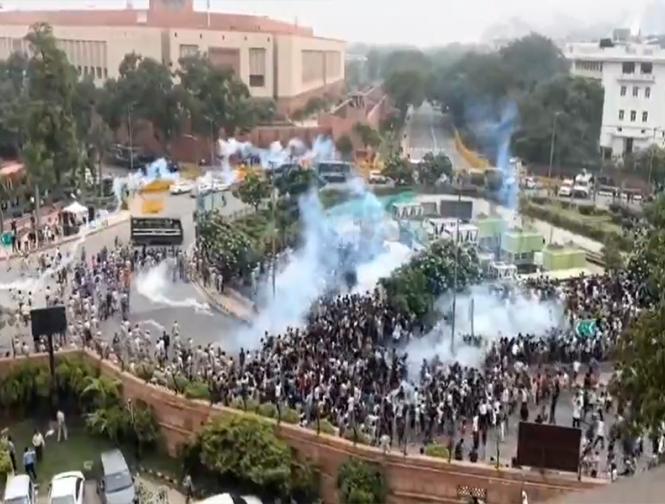
The youth are the greatest strength of any nation. However, the time has come for young people to decide for themselves whether this strength will be used for constructive change or squandered in violent protests in the name of caste, religion, language, reservation demands and political -interest.
There is a clear distinction between protest and violence. Violence undermines faith in democratic institutions and creates insecurity in the lives of ordinary citizens. Against the backdrop of violent protests in Maharashtra and various other parts of the country, young people must ask themselves a fundamental question: Is it really necessary to put my future at stake for taking to the streets?
Unemployment, Frustration and the Exploitation of Youth Sentiments
Today, young people face enormous challenges in completing their education, securing employment, supporting their families financially and building a stable future. The cost of education is rising, competition for jobs is becoming increasingly intense, and the nature of employment is changing across many sectors. It is natural for young people to feel frustrated and disappointed when they fail to secure the jobs they aspire to.
The government and society must take these concerns seriously. Employment generation, skill development, encouragement for industry and bridging the gap between education and employment are essential.
However, if young people’s emotions are exploited for political or organisational gain instead of addressing their problems, they must remain alert.
At times, the original issue takes a back seat, and the show of strength by political leaders becomes the principal objective of the agitation.
Young people must examine the purpose behind every protest, the credibility of its leadership, the practicality of its demands and the likely consequences of participating in it. They must compare the promises made in speeches with the actual benefits that reach them.
Protesters on the Streets; Decision-Makers in Safe Places!
One of the greatest tragedies of violent protests is that ordinary young youth often end up paying the price. Some of those who instigate or lead an agitation remain in safe surroundings, while the young people who respond to their calls and take to the streets face police action, arrest, court proceedings and financial losses.
When a protest involves stone-pelting, arson, vandalism of public property or violent clashes with the police, the consequences do not end that day. Those involved may have to face investigations, legal proceedings, lawyers’ fees and time away from work. In some cases, their education, employment prospects and social reputation may also suffer.
The situation becomes particularly serious when a young from an ordinary family has just completed an education and is searching for a job, or when the entire family depends on that person’s earnings. Household expenses, responsibilities towards parents, the education of siblings and the future may all be jeopardised.
By contrast, young people from financially well-off families may have greater resources to sustain a prolonged legal battle. Thus, the consequences of violent protests are not borne equally by everyone.
Before participating in any agitation, young people should therefore ask themselves:
- Who will take responsibility if I am arrested or face a court case?
- If my education or employment is jeopardised, who will stand by my family?
- Will the leaders of this agitation provide practical assistance when I am in difficulty?
These questions must be answered calmly and rationally, not in the heat of emotion.
Criminal Records, Employment and a Lifelong Price
In today’s employment market, educational qualifications and skills are important, but so are credibility, professional conduct and the background required for a particular position. Social media profiles are examined during recruitment and background verification. Depending on the job and applicable rules, an employer will scrutinise a candidate’s criminal background.
A pending case or an arrest can complicate the recruitment process and, in some circumstances, affect employment prospects.
An important distinction must be understood: the mere registration of a criminal case does not establish a person’s guilt. Nevertheless, allegations of involvement in a violent incident may lead to investigations and legal proceedings, causing mental stress, loss of time and financial hardship.
A decision taken in a moment of anger or excitement can have consequences lasting for years. Participating in an agitation is therefore not merely a decision about one particular day; it also requires an awareness of the potential consequences and a willingness to face them.
Patients, Senior Citizens and Persons with Disabilities Suffer
Vehicles caught in an agitation are not merely a matter of traffic congestion. Every minute is crucial for ambulance patients, people travelling for dialysis or routine medical treatment, pregnant women and citizens requiring emergency medical assistance.
If roads are blocked, their lives are put at risk.
Senior citizens face particular difficulties when they have to walk long distances, stand in crowded places, cope with uncertain bus or train services, or miss scheduled medicines and medical appointments.
The difficulties are even greater for persons with disabilities when alternative routes or accessible transport are not readily available.
Therefore, while assessing a protest, we must ask not only, “How many people participated?” but also, “How many vulnerable and helpless people were stranded because of it?”
Losses for Employees and Workers
Road blockades and shutdowns prevent employees from reaching their workplaces on time. Some may lose attendance benefits, others may face wage deductions, while daily-wage earners, contract workers and those employed in the informal sector may lose an entire day’s work.
Domestic workers, construction labourers, street vendors, drivers and small service providers depend on their daily earnings. For them, a shutdown often means one simple thing: no work today, no income today.
When employees cannot reach their workplaces, services are delayed and the burden on other workers increases. Hospitals, banks, offices, factories and essential services still need staff to report for duty despite the difficulties.
The burden of an agitation is not distributed equally. Economically weaker citizens often have no choice but to bear the losses directly.
Students’ Education and Future at Risk
The closure of schools and colleges, postponement of examinations, travel disruptions and interruptions to internet services can seriously disturb students’ education.
If transport is disrupted on the day of an examination, admission procedure or job interview, months of preparation and hard work may go to waste. If parents who depend on daily wages lose their income, the family’s ability to meet educational expenses may also suffer.
Young people are often encouraged to participate in agitations without being adequately informed about the consequences that may follow. Involvement in violent acts, vandalism of public property or violations of the law will lead to investigations, arrests, court proceedings and difficulties in continuing education or securing employment.
The political careers of leaders may continue, but a criminal allegation or prolonged legal proceedings can affect a young person’s education, career and family.
These concerns deserve serious attention.
The Economy, Industry and Employment Generation
Shutdowns, violent protests and transport disruptions damage shops, markets, industries, tourism, transportation and supply chains. Goods fail to reach their destinations on time, workers cannot report for duty, customers stay away from markets and business turnover declines.
Alongside large industries, small businesses suffer immediate financial losses. Street vendors, small restaurants, tea stalls, grocery shops and local transport operators often have limited reserves to absorb even a single day’s loss.
If instability becomes frequent, industries and investors may begin questioning whether business operations can continue without disruption. Repeated shutdowns, violence and uncertainty send a negative signal about the state’s ability to maintain a stable business environment.
Over time, this may affect new investments, industrial growth, employment generation and the opportunities available to local young people.
Thus, violence intended to advance a particular demand may ultimately damage the very employment prospects and economic opportunities that the youth desperately need.
Growing Polarisation in Society
Aggressive language, rumours and messages promoting hatred can simultaneously increase mistrust between communities.
When society becomes sharply divided into protesters and opponents, dialogue gives way to suspicion, hostility and conflict.
Social media makes the situation more dangerous when unverified information, provocative messages and selectively edited videos spread rapidly. Such content can inflame emotions, distort the facts and provoke reactions before people have had an opportunity to establish the truth.
Young people must learn to verify information before sharing it and resist attempts to turn legitimate grievances into hatred against other communities.
Increasing Burden on the Administration and Taxpayers
During large agitations, the police, traffic-control authorities, fire services, medical teams and local administration must deploy additional personnel and resources. The expenditure required to maintain law and order is borne by public funds.
When violence or vandalism occurs, the cost of repairing public buses, bus stops, railway facilities, shops and other damaged property adds to the burden.
An even more serious consequence is the diversion of administrative attention from other responsibilities. Time and personnel that could otherwise be devoted to routine security, citizens’ grievances, disaster management and local development become occupied with managing the agitation.
Even peaceful protests require careful planning when large crowds gather. Once violence begins, crowd management becomes considerably more difficult, dangerous and expensive.
Ultimately, taxpayers bear the financial burden, including citizens who may have had no connection whatsoever with the agitation.
Conclusion:
The power of ideas is greater than the power of violence. Creation is superior to destruction, and sound judgement is more valuable than blind obedience to leadership.
The nation does not merely need young people who take to the streets. It needs young citizens who respect the law, think independently and bring about change through their own abilities, determination and achievements.
Do not allow your future to become a tool for someone else’s political ambitions.
Ordinary families pay the heaviest price when protests turn violent. Do not trample upon the rights of fellow citizens while fighting for your own demands.
Every young person must remember that life is not an individual enterprise alone. Behind a young person’s education, upbringing and dreams for the future lie the hard work, sacrifices and hopes of an entire family.
Do not allow a moment of uncontrolled emotion to destroy those hopes.
Leaders will change. Political equations will change. The issues around which agitations are organised will also change. But the years, opportunities and peace of mind lost by a young person cannot easily be recovered.
A leader may move on to the next political campaign, but a young person may spend years dealing with the consequences of one impulsive decision.
Therefore, instead of becoming a puppet in someone else’s hands, the youth must take responsibility for their own future.
Fight for justice. But never sacrifice your education, career, family or future to violence.
Your energy is a national asset. Use it to build a stronger society, create opportunities and strengthen democracy—not to destroy the very future you are striving to secure