

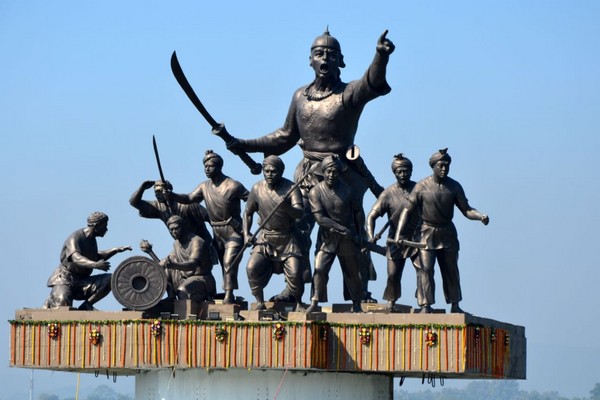
“When citizens read books, the nation progresses.”
On December 18th 2025, during the Pune Book Festival, the book ‘Lachit Barphukan’ by Arun Karmarkar was inaugurated. I was invited to attend as the Chief Guest. As we celebrate the birth centenary of Lachit Barphukan, this book provides a profound analysis of the military tactics and major battles fought by the man known as the “Shivaji Maharaj of Northeast India.”
Introduction
Throughout Indian history, many brave souls protected the motherland from foreign invaders. Just as Chhatrapati Shivaji Maharaj and Maharana Pratap stood firm in their regions, Lachit Barphukan was the leader who halted the aggressive expansionism of the Mughals in Northeast India. The history of this commander—who preserved Assam’s independence by defeating the massive army of Mughal Emperor Aurangzeb on the waves of the Brahmaputra River—is truly awe-inspiring.
A son of Assam and the commander of the Ahom Kingdom, Lachit Barphukan is one of the greatest heroes of Indian history, before whose bravery even the mighty Mughal power had to bow. The ‘Battle of Saraighat’ in 1671 was not just a war between two armies; it was an unprecedented struggle to maintain the freedom and identity of Assam.
Lachit Borphukan was the 17th‑century Ahom commander who saved Assam from Mughal conquest, especially through his brilliant leadership in the recapture of Guwahati (1667) and the Battle of Saraighat (1671).
Early life and background
Lachit Borphukan was born on 24 November 1622 at Charaideo in Assam, the youngest son of Momai Tamuli Borbarua, a powerful minister and military organizer of the Ahom kingdom.
Before rising to supreme command, Lachit held key posts such as Superintendent of the Royal Horses and of the Royal Household Guards, which gave him close contact with the Ahom court and the army’s functioning.
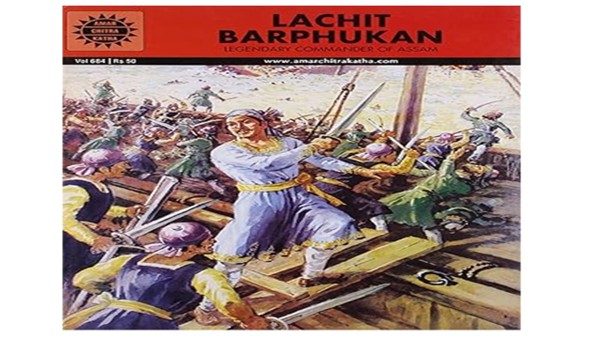 Rise to command and first campaigns
After the humiliating treaty with the Mughals following Mir Jumla’s invasion (1662–63), the new Ahom king Chakradhwaj Singha resolved to expel the Mughals from Assam and appointed Lachit as Borphukan (viceroy of western Assam) and commander‑in‑chief.
From his base at Kaliabar, Lachit advanced in August 1667 in two columns, conducted a series of engagements, and by the night of 2 November 1667 his forces recaptured the Itakhuli fort and Guwahati on both banks of the Brahmaputra, ejecting the Mughal garrisons.
Historical Background and the Mughal Invasion
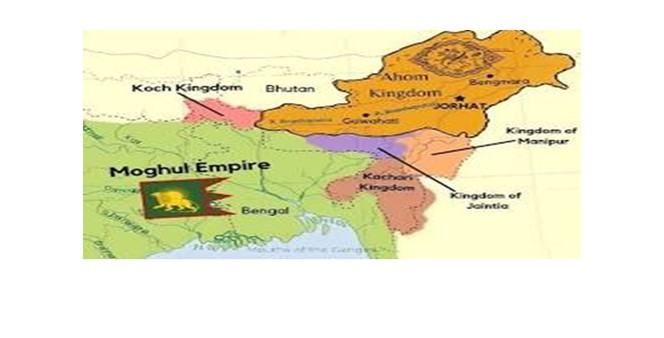
In the 17th century, Emperor Aurangzeb was attempting to bring all of India under his rule. The Ahom Kingdom of Assam became a thorn in the side of the Mughals. In 1663, the Mughal general Mir Jumla defeated the Ahoms, imposing a heavy tribute and annexing territory. King Chakradhwaj Singha could not tolerate this insult. He began preparations to reclaim the lost land and entrusted the leadership of this mission to Lachit Barphukan.
Leadership and Organizational Skills
Lachit Barphukan was not just a soldier but a brilliant strategist. He reorganized the army and, considering Assam’s geography (mountains, rivers, and dense forests), provided specialized training to the infantry and navy.
 A famous anecdote illustrates his discipline: while constructing a fortification (Momai-Kota Garh) to protect Guwahati, he found his own maternal uncle being negligent in his duties. Declaring, “My country is greater than my uncle,” Lachit beheaded him on the spot. This sent such a strong message of discipline through the ranks that the entire fortification was completed in a single night.
The Battle of Saraighat (1671): Strategy and Warfare
The Mughals sent a massive force under the leadership of Raja Ram Singh I of Amber. This army consisted of 30,000 infantry, 15,000 archers, 18,000 cavalry, and a vast artillery. In contrast, the Ahoms were outnumbered.
Lachit Barphukan knew that fighting the powerful Mughal cavalry on open ground would be suicidal. Therefore, he decided to utilize Guerrilla Warfare and naval expertise.
Battle of Saraighat: key events
Lachit deliberately avoided a decisive land battle, realizing that the Mughals’ strength lay in cavalry and infantry, while the Ahoms were superior in riverine warfare on the Brahmaputra.
He turned Guwahati–Saraighat into a killing zone by constructing mud embankments, stockades, and river obstacles, forcing the Mughals to fight on the water where their large but unwieldy fleet and cavalry were of limited use.
In the climactic phase at Saraighat (1671), when disease and exhaustion weakened the Ahoms and a Mughal assault seemed overwhelming, Lachit—seriously ill—had himself carried to a war boat and personally led a counter‑attack.
His sudden appearance and direct leadership transformed a wavering defense into a ferocious offensive; Mughal commanders like Munnawar Khan were killed in combat, their fleet thrown into confusion, and Ram Singh’s army forced to retreat beyond the Manas River, preserving Ahom independence.
Key Tactics of the Battle:
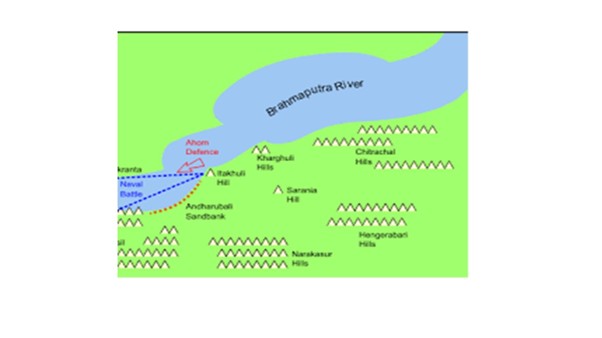
 Choice of Battlefield: Lachit cleverly chose the narrowest stretch of the Brahmaputra River at Saraighat. The narrow width rendered the large Mughal ships and heavy artillery ineffective.
- Fortifications: He built strong mud and bamboo forts (Garhs) on both banks. Forced by the impossible terrain on land, Ram Singh was compelled to use his navy.
- Guerrilla Tactics: Ahom soldiers would infiltrate Mughal camps at night to cut off supplies, exhausting the enemy’s morale before the main battle.
- Indomitable Will: On the day of the decisive battle, Lachit was severely ill. As the Mughals pressured the Ahom line and the soldiers began to retreat, Lachit had himself carried to a boat and shouted: “I do not wish to die leaving my country in danger; those who want to flee may do so!”
- Naval Victory: The Ahoms used small, agile boats (Bichari) that could maneuver quickly, while the large Mughal vessels got stuck. Seeing their dying commander fight like a tiger, the Ahom army launched a ferocious attack, leading to a humiliating defeat for Ram Singh.
Campaign against Mughal counter‑offensive
Aurangzeb reacted to the loss of Guwahati by sending a powerful army under Raja Ram Singh in 1669, supported by a large fleet and contingents from several sub‑ordinates.
Although the Ahom army was numerically weaker and not fully prepared, Lachit anticipated the danger, strengthened river defenses, improvised fortifications, and prepared his forces mentally and materially for a protracted struggle.
Legacy and historical portrayal
Lachit died in April 1672, about a year after the Saraighat victory, but his success ensured that the Mughal Empire never fully subjugated Assam and that the Ahom kingdom retained de facto independence.
His deeds are preserved in Assamese Buranjis (court chronicles), and modern Assam observes “Lachit Divas” on 24 November each year to honor his heroism and leadership, while Indian institutions highlight him as a model of regional resistance to imperial expansion.
Lachit Borphukan (1622–1672) was the legendary Commander-in-Chief (Borphukan) of the Ahom Kingdom. He is celebrated as the “Shivaji of the Northeast” for his unwavering patriotism and military genius, which halted the eastward expansion of the Mughal Empire under Aurangzeb.
Important Events of Lachit’s Life
- 24 November 1622: Born in Charaideo to Momai Tamuli Borbarua, a top Ahom official. He was trained early in military tactics, humanities, and statecraft.
- Early Career: He rose through various administrative and military ranks, serving as Soladhara Barua (King’s scarf-bearer) and Ghora Barua (Superintendent of Royal Horses) before becoming the Borphukan.
- Recapture of Guwahati (1667): Following the humiliating Treaty of Ghilajharighat (1663), King Chakradhwaj Singha tasked Lachit with reclaiming Ahom territory. Lachit brilliantly seized the Itakhuli fort in 1667, driving the Mughals back to the Manas River.
- The Battle of Alaboi (1669): Against Lachit’s tactical advice, the King ordered a direct assault on the Mughals. The Ahoms suffered a crushing defeat, losing 10,000 men. This setback taught Lachit that direct confrontation was a Mughal strength and must be avoided.
- The Battle of Saraighat (1671): The defining moment of his career. Despite being deathly ill, Lachit led the Ahom navy in a decisive battle on the Brahmaputra River, forcing the superior Mughal forces under Ram Singh I to retreat.
- 25 April 1672: Passed away in Kaliabor shortly after his victory, likely due to his prolonged illness.
Analysis of His Generalship
Assessment of his generalship
Lachit’s generalship rested on several strengths:
- Clear appreciation of relative strengths
- He correctly judged that frontal land battles against a larger, better‑equipped Mughal field army would be disastrous, so he shifted the theatre to rivers and hill‑lined narrows where Mughal cavalry and massed infantry could not deploy effectively.
- By exploiting Assamese expertise in boat‑building, river navigation, and guerrilla‑style river combat, he converted a material inferiority into operational advantage.
- Strategic patience and defensive offense
- Instead of chasing glory in open battle, Lachit focused on holding the Guwahati–Saraighat line, fortifying key positions and wearing down the enemy through attrition, harassment, and controlling the river approach.
- His recapture and retention of Guwahati after 1667 shows a long‑term view: secure the strategic gateway to upper Assam and deny the Mughals a forward base.
- Command, discipline, and personal example
- Lachit was famous in Assamese chronicles for strict discipline; in one well‑known episode (often cited in later tradition) he is said to have punished even close kin who neglected their duties, reinforcing the principle that the state came before family.
- At Saraighat, his decision to fight despite grave illness and to lead from the front restored morale when subordinates hesitated, showing a combination of moral courage and physical bravery that is central to effective command.
- Use of terrain, logistics, and deception
- He chose narrow, curved river stretches and prepared hidden positions and embankments, compelling Mughal ships to break formation and come under concentrated fire from Ahom boats and shore batteries.
- By feints, sudden night attacks, and cutting enemy supply lines, he prolonged the campaign until Mughal forces became demoralized and overstretched far from their main bases in Bengal.
Lachit Borphukan’s military leadership is studied today as a masterclass in asymmetric warfare—where a smaller, weaker force defeats a superpower.
Exploiting Geography (Terrain as a Weapon)
Lachit knew the Mughals were invincible on open plains with their elite cavalry. He forced the war into the hills and the river.
- Strategic Narrowing: He chose Saraighat as the battlefield because it was the narrowest point of the Brahmaputra (about 1 km), neutralizing the Mughal advantage of numbers.
- Mud Embankments (Gars): He built a complex system of ramparts and trenches around Guwahati, making it a “fortress city” that could only be attacked by water.
Naval Innovation and Logistics
He transformed the Ahom navy into a highly mobile force.
- Small vs. Large Boats: The Mughals used large, heavy ships. Lachit used smaller, agile boats that could navigate shallow waters and execute rapid “hit-and-run” strikes.
- Boat Bridges: He pioneered the use of temporary boat bridges to transport supplies and soldiers across the river, maintaining constant pressure on the enemy.
Psychological and Guerrilla Warfare
- Night Raids: He used guerrilla tactics to harass the Mughal camps at night, keeping them sleep-deprived and paranoid.
- Misinformation: He used spies to spread rumors that the Ahom army was aided by “demons,” demoralizing the Mughal ranks through psychological fear.
Ethical Leadership and Discipline
Lachit’s leadership was defined by “Duty above Kin.”
- The Sacrifice of His Uncle: When his own maternal uncle was negligent in completing a critical rampart (the Momai-kota Gar), Lachit executed him on the spot, declaring: “My uncle is not greater than my country.” This act ensured absolute discipline and urgency across his entire army.
Comparison of Forces at Saraighat
| Feature | Mughal Empire (Ram Singh I) | Ahom Kingdom (Lachit Borphukan) |
| Strengths | Heavy Cavalry, Large Galleons, Massive Infantry | Naval Agility, Guerilla Tactics, Terrain Knowledge |
| Numbers | ~30,000+ Infantry, 18,000 Cavalry | Smaller, militia-based (Paik system) |
| Strategy | Open field engagement | Riverine defense & psychological war |
Analysis of Military Skills
Lachit Barphukan’s style of warfare was a masterclass in:
- Guerrilla Tactics: Striking the enemy’s weaknesses (the navy) rather than their strengths.
- Intelligence: Weaving an accurate spy network to track Mughal movements.
- Resourcefulness: Defeating a modern-armed superpower using bamboo forts and agile boats.
- Public Participation: This was not just a soldier’s war, but a war fought by every citizen of Assam.
Conclusion
The victory at Saraighat was a victory for India’s identity. If Lachit had not stopped the Mughals there, the cultural and political map of Northeast India would be different today.
Sadly, this great hero passed away shortly after the victory due to his failing health. Today, the best cadet at the National Defence Academy (NDA) is honored with the ‘Lachit Barphukan Gold Medal.’ He will forever be remembered as the “Chhatrapati Shivaji Maharaj of the East.”
Poem: Brave Lachit Barphukan
On the waves of Brahmaputra, he wrote history, He turned the Mughal pride into mere dust and mystery. Be it uncle or kin, he chose the nation’s rite, For his country’s sake, he led the bloody fight.
Despite his burning fever, he roared upon the field, “I shall never surrender,” was the only vow he’d yield. A sea of guerrilla tactics, strategy, and might, At Saraighat, he became the enemy’s darkest night.
We bow to you, O Hero, the soul of Assam’s land, Lachit, your name is eternal, India’s glory grand!







Excellent . Every Indian should know about this brave Indian patriot warrior who defended and defeated the muslim invaders of his land .