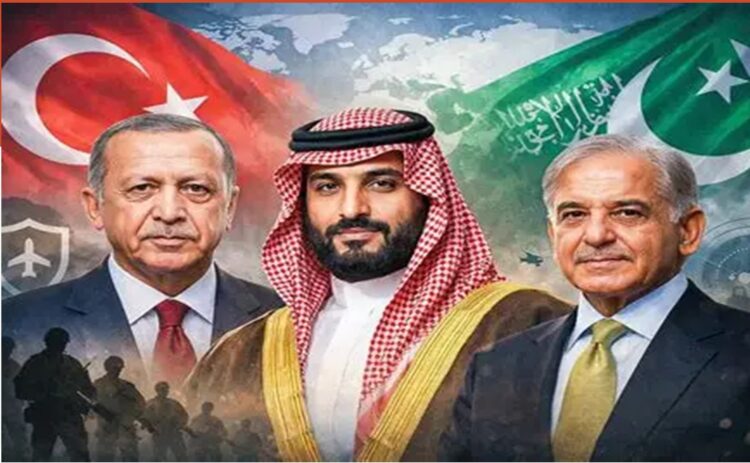
The Mecca Joint Defence Agreement, signed on 7 August 2026 in Mecca by Saudi Crown Prince Mohammed bin Salman, Turkish President Recep Tayyip Erdoğan, and Pakistani Prime Minister Shehbaz Sharif, is a trilateral mutual defence pact. It stipulates that an armed attack against any one of the three states “shall be regarded as an attack against them all,” and provides for enhanced defence cooperation, including potential joint exercises, technology transfers, intelligence sharing, and defence-industrial collaboration.
It builds directly on the September 2025 Strategic Mutual Defence Agreement between Saudi Arabia and Pakistan (under which Pakistan has already deployed fighter jets, air-defence systems such as the Chinese HQ-9, and troops to Saudi bases). Officials from all three sides describe it as purely defensive, grounded in UN Charter Article 51 (self-defence), open to other regional states, and not aimed at creating a sectarian bloc, nuclear axis, or replacement for existing alliances. It is frequently labelled an “Islamic NATO” in media and by some Pakistani voices, but it lacks NATO’s integrated command, permanent forces, standardised doctrines, or automatic response mechanisms.
Compulsions, Reasons, and Motivations
The three countries share overlapping but not identical drivers rooted in the prolonged Middle East instability since October 2023 and especially the US-Israeli war against Iran that escalated sharply around late February 2026. Iranian and proxy (Houthi, Iraqi militia) missile and drone attacks have repeatedly struck Gulf energy infrastructure and shipping, disrupting the Strait of Hormuz and Red Sea routes critical to global oil flows. Gulf states have openly questioned the reliability and sufficiency of the US security umbrella.
- Saudi Arabia seeks diversified deterrence and self-reliance. It already had long-standing (if limited) defence ties with Pakistan and the GCC collective defence arrangement. The pact adds Turkish military-industrial capacity and reinforces Pakistani manpower while signalling regional leadership and reducing sole dependence on Washington.
- Pakistan gains economic relief, strategic prestige, and deeper embedding in Gulf security architecture. It contributes battle-tested forces and (symbolically) its status as the only nuclear-armed Muslim-majority state, while receiving Saudi financing and access to Turkish systems.
- Turkey expands its regional influence and defence-industrial markets. As a NATO member with the alliance’s second-largest army and a mature drone/UAV and naval industry, it gains Saudi capital and a platform for greater autonomy in a multipolar order.
Shared motivations include collective deterrence against external aggression, promotion of “Islamic solidarity” framing for domestic audiences, and hedging against great-power unpredictability.
Aspect of the Gulf Dimension of the Iran War That Accelerated the Saudi Move
The decisive accelerator was the pattern of direct and proxy Iranian attacks on Saudi and other Gulf energy facilities, desalination plants, and maritime traffic after the US-Israeli operations against Iran began. These strikes exposed the vulnerability of critical infrastructure and the limits of rapid, decisive US protection, even as Washington remained the primary security partner. Houthi attacks from Yemen intensified in parallel. Saudi Arabia had already formalised the bilateral pact with Pakistan in 2025; talks to bring in Turkey, underway for roughly a year (or longer according to some Turkish statements), were accelerated by the need for broader, more credible conventional deterrence and air-defence depth.
Fear Behind the Saudi Move
The core fear is Iranian escalation and proxy warfare that could devastate Saudi oil exports, Vision 2030 economic transformation goals, and domestic stability—combined with uncertainty over sustained US willingness or capacity to deter or respond decisively. Riyadh seeks insurance through multiple overlapping partnerships rather than exclusive reliance on any single external guarantor.
Turkey’s Motivation
Ankara prioritises strategic autonomy, defence-industry exports (especially drones and related systems already purchased by Riyadh), and elevated regional status. The pact expands an existing web of Turkish partnerships (Qatar, parts of Syria/Libya) into a larger Muslim-majority collective-defence mechanism, enhances deterrence signalling toward Israel (with which relations are fraught), and positions Turkey inside emerging energy/trade networks linking the Gulf, South Asia, and Europe. Turkish officials emphasise it is complementary to NATO membership, not a substitute, and open to further members (Egypt has been mentioned as a possible future partner). Economic benefits from Saudi funding are material given Turkey’s own fiscal pressures.
Economic and Strategic Compulsions
Economically, the complementary strengths are clear: Saudi financial resources and energy leverage; Turkish advanced conventional defence industry and NATO-standard training/doctrine; Pakistani manpower, operational experience, and nuclear deterrent (though officials have previously clarified no automatic nuclear umbrella). Joint production, technology transfer, and Saudi funding of Pakistani deployments reduce costs for all while creating mutual dependence. Strategically, it raises the threshold for attacks on any member, provides diplomatic weight in mediation or crisis management, and hedges against both Iranian power projection and perceived US retrenchment or selective engagement. It also supports maritime security initiatives for energy routes.
NATO and American Views
Turkey has repeatedly stated the pact does not conflict with NATO obligations (Article 8 of the North Atlantic Treaty permits external arrangements that do not contradict the Washington Treaty) and is not a rival alliance. An attack on Saudi Arabia or Pakistan would not automatically trigger NATO Article 5. The United States has issued no detailed official reaction in the immediate aftermath. Analysts note that all three signatories are longstanding US partners (Turkey as NATO ally, Pakistan as major non-NATO ally, Saudi Arabia as major arms purchaser and basing host). Washington may view it as useful burden-sharing and regional self-help, while remaining wary of escalation risks, resource diversion for Turkey, any nuclear signalling, or reduced US leverage. The pact reflects a judgment that US guarantees alone are no longer viewed as fully sufficient.
Comparison with the India–Israel–UAE–Cyprus–Greece Alignment
This is not a formal mutual-defence treaty with an “attack-on-one” clause. It is a looser, multi-layered network of deepening bilateral and minilateral defence, technology, maritime, and economic partnerships. Key elements include:
- Robust India–Israel defence-industrial and operational cooperation.
- India–UAE Strategic Defence Partnership framework (defence industry, training, cyber, maritime security).
- Greece–Cyprus–Israel trilateral military cooperation, expanding toward a “Mediterranean Quad” or “3+1” format that includes India.
- Israeli conceptual advocacy for a broader front “from India through the UAE to Greece and Cyprus,” overlapping with the India-Middle East-Europe Economic Corridor (IMEC) logic.
Shared interests centre on countering Iranian power projection, radical non-state actors, maritime security, advanced air/missile defence, and technological innovation. UAE and Saudi Arabia themselves maintain strong economic and strategic ties with India, creating overlapping rather than purely antagonistic geometries. The Mecca pact is more formalised on collective defence language and draws on Islamic solidarity framing; the India-centred network is more flexible, technology- and economy-driven, and includes non-Muslim states with NATO links (Greece). Both reflect multipolar hedging amid the same regional wars, but they are not mirror images.
Impact on India–Pakistan Strategic Equations in South Asia
The pact elevates Pakistan’s diplomatic and prestige profile by linking it formally to two major Sunni powers and provides potential access to additional financing and Turkish defence technology (already significant via drones and naval cooperation). Pakistani officials have at times framed broader “Islamic” solidarity in ways that allude to India or Kashmir, raising concerns in New Delhi about possible multilateralisation of bilateral disputes or diplomatic cover during crises.
In practice, automatic military involvement by Saudi Arabia or Turkey in an India–Pakistan conflict is highly improbable. Both maintain substantial economic, energy, diaspora, and strategic interests with India; Saudi–India relations in particular have deepened significantly. Invocation of the collective-defence clause would require alignment of national interests that do not currently converge against India. The main effects are likely to be:
- Incremental improvement in Pakistan’s military modernisation and economic resilience.
- Greater Indian vigilance and acceleration of its own multi-alignment (deeper Gulf, Israeli, Mediterranean, and Quad-linked partnerships).
- Continued Saudi balancing rather than exclusive tilt.
- Heightened sensitivity around any nuclear or advanced conventional technology transfers.
Conclusion
The primary theatre of the Mecca pact remains West Asian deterrence against Iran and proxies, not the subcontinent. Its credibility will be tested by whether the parties actually coordinate in a real crisis; historical analogues (including the prior Saudi–Pakistan arrangement) suggest political signalling often exceeds operational automaticity. India retains strong independent capabilities and diversified partnerships that limit any decisive shift in the South Asian balance.