The Middle East’s political map is being redrawn not only by missiles, drones , blockades and stuck tankers but by a quieter, more inexorable force: the coming peak and possible decline of oil demand in the world’s largest consuming markets. For Saudi Arabia, whose future of sustained state finances depends on MBS’s ambitious Vision 2030 — designed to transition the Saudi economy from hydrocarbons to a non-fossil-fuel economy to avert economic downfall and secure its own future economic survival — everything is hinged on the vital need for regional peace and stability. This is not a slogan or fanciful idealism but an absolute existential necessity, one that is eluding Saudi Arabia right now. Saudi stakes in peace and stability in the Middle East are far too high in all that is happening there, and this can be a make-or-break moment for MBS.
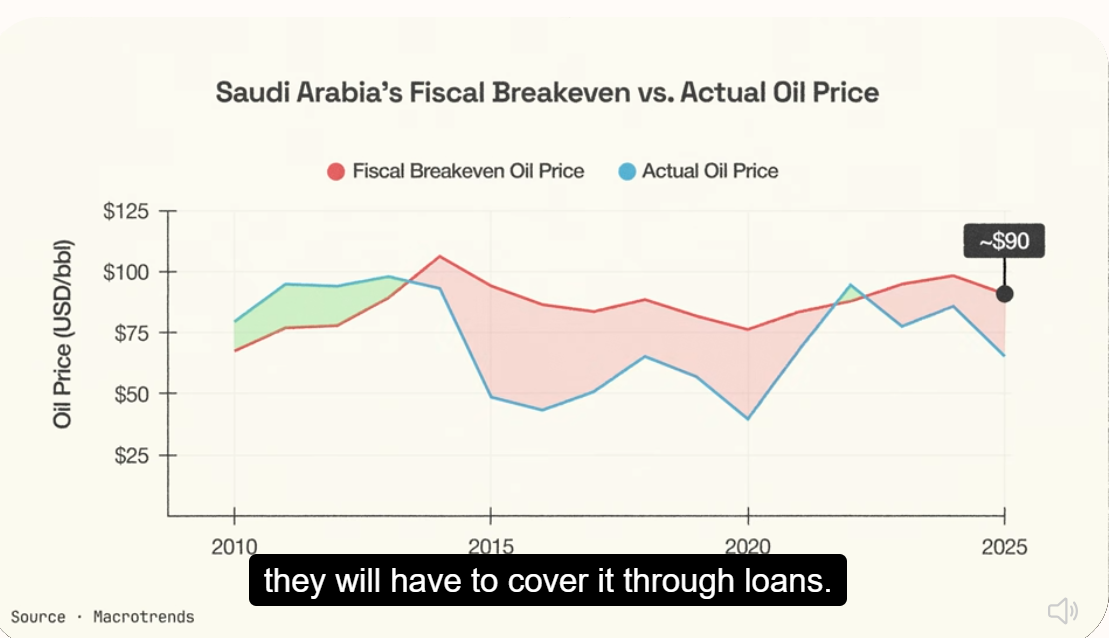 Even now, Crown Prince Mohammed bin Salman’s domestic budget cannot fully fund the massive reconstruction and infrastructure programme he has undertaken. Revenues would still fall short even if Saudi Arabia restored pre-war oil output and sold that crude at $76 a barrel. To cover the basic budgetary needs of Vision 2030, Riyadh needs international oil prices to stay above $90 a barrel. The war with Iran therefore initially looked like a boon for Rhiyad. But Houthi attacks on Saudi oil production and shipments have turned that advantage into something close to an economic catastrophe for the kingdom.
The argument that I am going to make in the following paragraphs is not that demand for oil in the world is going to disappear overnight tomorrow. It is that the combination of structural demand risk, fiscal vulnerability, a scramble among producers to monetize reserves while prices remain high, and persistent Iranian-backed disruption of the two great chokepoints leaves Riyadh with a narrowing set of strategic options. Formal alignment through the Abraham Accords is the most coherent remaining path to the stability Mohammed bin Salman needs. Demand is no longer a one-way bet. Forecasts for oil demand through 2030–2050 diverge sharply, and that divergence itself is the point. OPEC’s 2026 World Oil Outlook sees no peak this side of 2050 and projects global demand rising toward 124 million barrels per day, driven by India, other non-OECD Asia, Africa, and petrochemicals.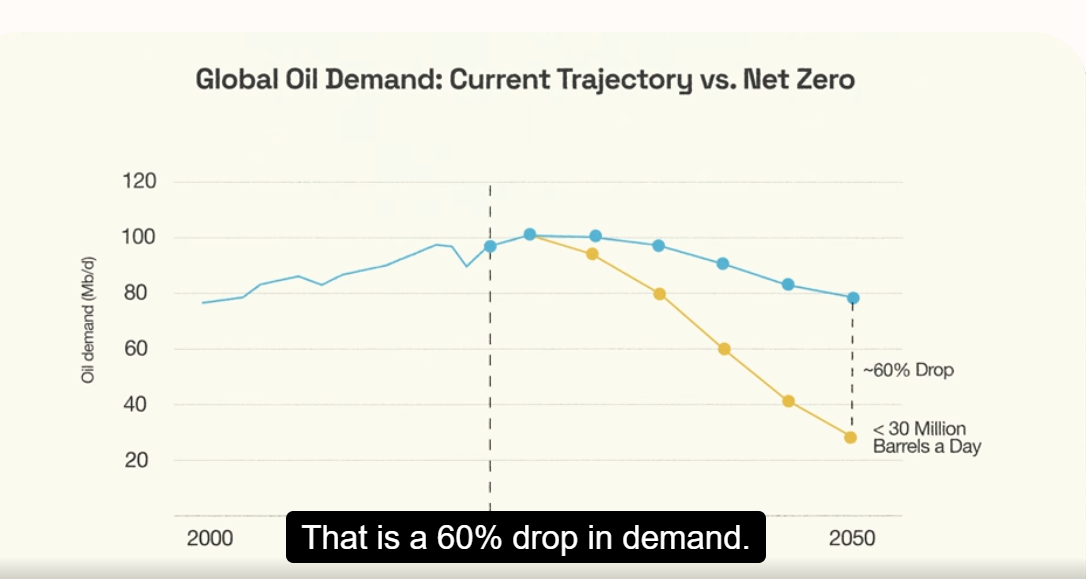
The International Energy Agency’s scenarios have long pointed the other way: oil demand peaking before or around 2030 in stated-policies cases, then declining as electric vehicles, efficiency, and renewables bite, especially in China and OECD Europe.The regional picture is already visible. OECD Europe’s oil use is structurally falling in both OPEC and IEA outlooks. China’s growth has slowed; EVs displaced an estimated 1 million barrels per day of Chinese oil demand in 2025, and IEA figures put global EV displacement at 1.7 mb/d that year, rising toward 5 mb/d by 2030 under current policies. India remains a major source of incremental demand, but even there two- and three-wheeler electrification is beginning to matter. Europe’s policy and China’s industrial strategy are not “green slogans.” They are capital allocation at continental scale. Anyone who takes for granted the same level of oil demand in 2050 as a certainty is betting against an imminent oil-price collapse in the coming decades.
A prolonged glut in global oil production, caused by a mad rush of oil-rich countries to ramp up production before their reserves become worthless, would not merely hammer down the international price of oil in the coming years but would also lower the present value of every undeveloped reserve. That is why Trump, who can still pump cheaply in America, and Venezuela have a huge incentive to produce more now, while the sun is still shining. This is a trend that cannot be reversed now, and this is exactly what Crown Prince Mohammed bin Salman is watching Saudi Arabia miss, helplessly unable to stop either the Houthis or Iran from ruining his present as well as his future plans.The Saudi fiscal problem is not just diversification of the economy — peace and stability is a mandatory component of it. Vision 2030 has delivered measurable change in Saudi Arabia but is still grossly incomplete. Hydrocarbons still dominate export earnings and a large share of the budget. Estimates of the 2026 fiscal breakeven oil price cluster in the $80–96 range for the central government, and higher when Public Investment Fund domestic spending is included.
The 2026 Iran war illustrated the trap. Production and Hormuz exports were disrupted; prices spiked; volumes fell. Higher prices offset some of the volume loss in quarterly accounts, but they also revealed how little room there is if both price and volume go the wrong way at once. A kingdom that must fund giga-projects, social outlays, and a large public sector cannot treat a multi-decade demand plateau or decline as a distant academic debate. It needs either durable high prices, a much larger non-oil tax base, or both — and it needs them in a region that does not keep exploding.
The bottom line is – Vision 2030 requires a quiet neighborhood. Mohammed bin Salman understood the oil-clock problem early. The 2030 program was always a bet that the Kingdom could convert remaining hydrocarbon wealth into a logistics, tourism, mining, entertainment, and investment hub before the rent declined. The catch is that UAE-style diversification can work only with investors’ confidence — i.e., a strong investor belief that the airports, ports, and giga-projects will not be within range of ballistic missiles and drones. That requirement is incompatible with an unconstrained “axis of resistance.” The IRGC’s jihadi expeditionary model, export of Islamic terrorism, Houthi control of Yemen’s Red Sea coast and approaches to Bab el-Mandeb, Hezbollah’s residual capacity, Iraqi Shia militias, and Palestinian factions that treat instability as leverage, all of them raise the risk premium on every Saudi project.
In September 2026 the Houthis seized Mocha and islands commanding Bab el-Mandeb after a rapid coastal offensive, while Saudi air defenses intercepted a drone near Mecca. Saudi crude loadings through the southern Red Sea corridor had already been cut roughly in half after earlier attacks. With Hormuz still contested after months of war, the Kingdom faces a two-strait problem: its eastern export route and its western alternative can both be held at risk by Iranian-aligned forces.Stabilizing that map is not a moral abstraction. It is a condition for the non-oil economy. A “win” for the United States and Israel against Iran’s expeditionary system, and a decisive Saudi outcome against the Houthis, would not produce utopia. It would reduce the frequency with which rockets and mines price Saudi risk.
Why the Mecca Pact is not enough ?
In August 2026 Saudi Arabia, Turkey, and Pakistan signed a mutual-defense agreement in Mecca: an attack on one to be treated as an attack on all, with a secretariat in the Kingdom. The pact was a serious attempt to build a third pole that was neither Israeli nor Iranian, and brought on table the requisite capital i.e. a NATO-experienced military-industrial base, and a nuclear-armed partner into the same frame. Unfortunately It has proven to be a cold start and its ability to deliver remains dubious.
Weeks after the signing, Houthi advances on the Red Sea coast and a drone incident near Mecca showed that a paper commitment among distant capitals does not automatically generate the intelligence fusion, air-defense density, or coastal denial needed against a militia that has spent a decade learning to fight Saudi-backed forces. Turkey and Pakistan have other theaters. None of the three signatories can, by itself, reopen Hormuz or hold Bab el-Mandeb. The pact seems has a long way to go to be effective in solving Riyad’s immediate problems. As of September 2026, the pact has failed to be effective in neutralizing the actors who can still close Saudi export routes and terrorize cities.
Earlier intra-Arab or China-brokered arrangements with Tehran similarly failed to retire the proxy toolkit. Deterrence that does not change the cost-benefit calculation of the IRGC and its partners is not deterrence; it is a ceasefire between rounds.
Conclusion
The logic of the preceding sections converges on a single operational conclusion. Saudi Arabia cannot complete the shift from a fossil rentier state to a non-fossil, investment-and-services economy while the region remains a theater of revisionist militias, contested chokepoints, and periodic wars. Tourism, logistics hubs, sovereign-fund co-investment, and private capital all require a multi-year horizon of predictability. That horizon does not exist if Hormuz can be throttled, Bab el-Mandeb can be held at gunpoint, and holy cities can be buzzed by drones. Diversification documents do not repeal geography.
Hedging has been tried. The China-brokered thaw with Iran did not dismantle the proxy system. The Mecca defense pact, whatever its long-term potential, has not yet produced the security environment Vision 2030 needs. Unilateral Saudi air campaigns against the Houthis have not ended the Red Sea threat. Waiting for a comprehensive Palestinian settlement before any other effective alignment in middle east take place amounts to a decision to keep the non-oil project hostage to a conflict that has outlasted every diplomatic formula of the last half-century.
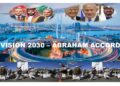
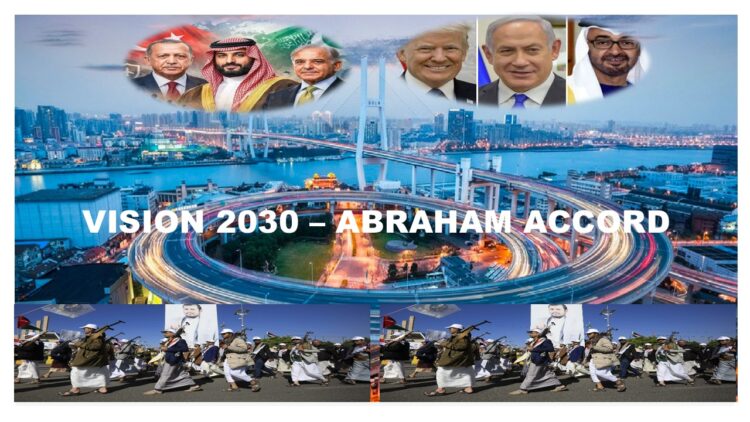
What remains is a coalition that already exists in embryonic form and can be turned into a formidable force if Saudis put their stamp on it. The United States, Israel, and the Arab states of UAE, Bahrain, Morroco , Sudan have already come together to form the Abraham Accords. Washington supplies the naval and political weight that still matters at the two straits and in the Gulf. Israel supplies the intelligence, air-defense, and strike capacity that has repeatedly degraded Iranian and proxy infrastructure. The UAE, Bahrain, and other Accords partners supply the commercial and diplomatic proof that open relations with Israel are compatible with Gulf security and economic modernization. Saudi accession would turn that cluster into a critical mass: the largest Arab economy, the custodian of Islam’s holiest sites, and the state whose oil still sets the fiscal weather of the region, formally inside the same security and diplomatic architecture. Trump had been cajoling MBS to shed his hesitations and join the Abraham Accord to complete and cement the middle east security architecture that alone was capable of dealing and neutralizing the axis of resistance headed by the Islamic Regime of Iran. Time has come when Saudi Arbia will have to boldly choose between the intractable Palestinian cause or its own economic survival.
That is not a claim that the Accords will abolish every grievance or produce instant peace. It is a claim about sequencing. First the spoilers must be constrained enough that rockets and mines cease to be a routine pricing factor. Only then can the non-fossil economy—ports that stay open, airports that attract tourists, giga-projects that attract equity rather than war-risk premia—have a realistic chance of succeeding on the timetable the oil market is imposing. Without that stability, Vision 2030 remains a set of impressive non-oil GDP statistics funded by a treasury that is still one strait closure away from crisis.
For Riyadh, therefore, joining the Abraham Accords should no longer be considered a compromise of an article of faith, a moral dilema, or a concession extracted by Washington. It is perhaps the last remaining instrument through which Saudi Arabia, the United States, Israel, and Arab allies can impose enough order on the Middle East for the post-oil project of MBS to be more than a brochure. The oil years are finite. The window in which those years can still finance a different kind of state is shorter still. That is why the Abraham Accord is not merely an answer. It is perhaps the only option that is left for Riyadh. Alternative is to swallow the Sunni pride , capitulate and submit to Shia domination of middle east by the Islamic Regime of Iran, live under their terror , bully and gun perpetually held at the head through the rag tag Houthi terror proxy for a perpetual black mailand extraction of whimsical terms by the gatekeepers of Hormuz and Ba-al-Mandeb and the Exis of evil.