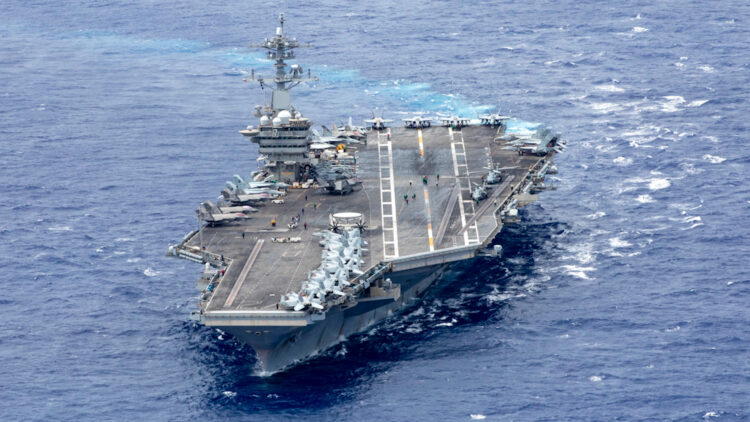
The aircraft carrier has long been the symbol of American military power. For more than eight decades, U.S. Carrier Strike Groups have enabled Washington to project military force across the globe, reassure allies, deter adversaries, and respond rapidly to crises. From the Pacific campaigns of World War II to the Persian Gulf, Afghanistan, Iraq, and recent operations in the Middle East, aircraft carriers have represented the visible embodiment of American global supremacy.
However, the recent experience of USS Abraham Lincoln has exposed a critical vulnerability that no amount of advanced technology can completely overcome—the limits of human endurance.
The carrier’s nearly nine-month deployment in support of operations connected to the Middle East conflicts reportedly left thousands of sailors and Marines facing severe fatigue, uncertainty, and psychological stress. Reports from military publications, family members, and media investigations described declining morale, prolonged periods without significant port visits, and growing concerns about mental health among the crew. Some reports even alleged attempts by sailors to jump overboard during the deployment, though the U.S. Department of Defense disputed parts of these accounts. Nevertheless, the debate itself has highlighted the human cost of prolonged military operations.
The USS Abraham Lincoln episode provides an important case study not only for the United States but for every major military power, including India. It demonstrates that future wars will not be decided solely by advanced weapons, artificial intelligence, drones, hypersonic missiles, or cyber capabilities. They will also depend on logistics, industrial capacity, manpower reserves, and the ability of soldiers, sailors, and airmen to endure prolonged conflict.
History’s Lesson: Great Powers Often Lose Wars of Endurance
Military history repeatedly demonstrates that technological superiority alone does not guarantee victory.
Napoleon’s Grand Army was the most powerful military force in Europe, yet it collapsed during the Russian campaign of 1812 because logistics and endurance failed.
During World War II, Germany possessed some of the most advanced military equipment of its era. However, the inability to sustain prolonged warfare against the combined industrial capacity of the Soviet Union, Britain, and the United States eventually led to defeat.
The United States itself experienced this reality during the Vietnam War. Despite overwhelming military superiority, advanced air power, and economic strength, Washington failed to achieve its political objectives because North Vietnam demonstrated greater strategic endurance and national resilience.
Similarly, in Afghanistan, the United States maintained military dominance for two decades but ultimately withdrew after a prolonged conflict that exhausted political will and resources.
The central lesson from these conflicts is simple: wars are often won not by the strongest army at the beginning, but by the side that can sustain the struggle the longest.
The Human Dimension of Naval Warfare
Aircraft carriers are frequently portrayed as floating cities equipped with sophisticated technology. Yet life aboard these vessels remains physically and psychologically demanding.
Thousands of personnel live in confined spaces while operating around the clock. Flight deck operations continue day and night. Crew members work long hours under dangerous conditions involving jet aircraft, heavy machinery, and live weapons.
Under normal circumstances, periodic port visits allow sailors to rest, interact with families, and recover mentally. Reports indicate that USS Abraham Lincoln spent more than 240 to 250 consecutive days at sea with extremely limited opportunities for such recovery. Military experts have noted that such prolonged deployments can significantly affect morale and operational effectiveness.
History provides numerous examples of morale affecting combat outcomes.
During World War II, the Japanese Navy suffered severe morale problems as the war turned against Japan. During the final years of the conflict, shortages of fuel, food, and rest significantly reduced operational efficiency.
Similarly, Soviet troops in Afghanistan and American troops during extended deployments in Iraq experienced psychological strain that affected combat effectiveness.
Military power ultimately depends upon human beings. A tired operator controlling a missile system, a fatigued pilot conducting carrier operations, or an exhausted radar controller can make errors with strategic consequences.
Logistics: The Invisible Foundation of Military Power
Military theorists often describe logistics as the “lifeblood of war.”
General Omar Bradley famously observed that “amateurs talk strategy; professionals talk logistics.”
The USS Abraham Lincoln experience reinforces this principle. Sustaining a carrier strike group thousands of kilometers from home requires a continuous flow of fuel, food, ammunition, spare parts, and maintenance support.
The ongoing conflicts in the Middle East have imposed substantial logistical demands on the U.S. military. Missile inventories, precision-guided munitions, and naval resources have been consumed at rates higher than anticipated. Extended deployments have increased maintenance requirements and operational costs.
The Russia-Ukraine war has revealed the same reality on a larger scale. Both sides have consumed enormous quantities of artillery shells, missiles, drones, armored vehicles, and manpower.
The lesson is clear: industrial capacity and logistics determine whether military power can be sustained over time.
Russia’s Manpower Challenge and the Attrition Factor
The Russia-Ukraine war has become one of the largest wars of attrition since World War II.
Recent Western assessments suggest that Russia is currently losing approximately 6,000 more troops per month than it can recruit, despite recruiting roughly 1,000 personnel per day. Analysts also warn that any new large-scale mobilization could carry significant political and economic risks for Moscow.
Even where estimates vary, multiple studies indicate continuing manpower pressures on Russian forces and difficulties in replacing battlefield losses.
This highlights a fundamental truth of warfare:
A military can replace equipment relatively quickly; replacing trained soldiers, sailors, pilots, and officers is far more difficult.
The death or injury of experienced personnel creates losses that cannot be immediately compensated through recruitment alone.
Strategic Consequences for the Indo-Pacific
One of the most significant implications of the USS Abraham Lincoln deployment concerns the Indo-Pacific balance of power.
American military planners increasingly regard China as the principal long-term strategic competitor. Yet crises in the Middle East continue to absorb substantial U.S. military resources.
Whenever aircraft carriers, destroyers, missile-defense assets, and logistics ships are tied down in one theater, fewer assets remain available elsewhere.
This creates opportunities for Beijing.
China has spent the past decade transforming reefs and artificial islands in the South China Sea into heavily fortified military installations equipped with airfields, radar networks, missile batteries, and naval infrastructure.
Should U.S. naval presence decline for extended periods, China could seek to strengthen its influence around Taiwan, the South China Sea, and critical maritime chokepoints.
For India, this development has direct strategic implications because the Indo-Pacific has become the center of global economic and military competition.
Why the South China Sea Matters to India
Many Indians view the South China Sea as a distant issue. In reality, it is directly linked to India’s economic and energy security.
A significant portion of India’s trade with East Asia passes through these waters. Energy imports, manufactured goods, electronic components, and commercial shipping all depend upon freedom of navigation.
If a single power were to dominate these sea lanes, the consequences could affect regional commerce, energy flows, and supply chains across Asia.
For this reason, India has consistently supported a free, open, and rules-based Indo-Pacific.
The strategic importance of maritime security will only increase in the coming decades.
Lessons from Siachen, Kargil, and Indian Military Experience
India has its own experience with long-duration military deployments.
For more than four decades, Indian soldiers have served in Siachen under some of the harshest conditions on Earth.
Similarly, troops deployed in Ladakh, Jammu and Kashmir, and the Northeast routinely operate in challenging environments for extended periods.
The Kargil War demonstrated the importance of maintaining reserves, logistics infrastructure, and rapid reinforcement capability.
Operation Parakram revealed another critical lesson: large-scale mobilization requires enormous logistical support and sustained political commitment.
Unlike short wars of the twentieth century, future conflicts may continue for months or even years.
India must therefore prepare not merely for high-intensity combat but for sustained military operations.
The Importance of Military Reserves
The Russia-Ukraine war has revived interest in reserve forces worldwide.
Modern warfare consumes manpower at a rate that professional standing armies alone may struggle to replace.
In India’s context, the Agnipath scheme could eventually contribute to a trained reserve pool. Former Agniveers, after completing their service, could become an important component of India’s national reserve structure during major emergencies or prolonged conflicts.
Several successful military powers—including Israel, Switzerland, Finland, and South Korea—rely heavily on reserve systems.
India may need to further develop its reserve force framework as part of long-term national security planning.
Mental Health: A Strategic Resource
Military organizations have traditionally emphasized physical fitness and combat skills. However, twenty-first-century warfare has elevated mental resilience to equal importance.
Continuous deployments, information warfare, cyber threats, social media pressure, family separation, and operational uncertainty create unprecedented psychological burdens.
The experiences reported from USS Abraham Lincoln illustrate how mental fatigue can become a strategic issue rather than merely a medical concern.
For India, investment in military mental-health programs, counselling systems, stress management, family support networks, and leadership training should be regarded as national-security priorities.
Preparing India for Future Long Wars
The future battlefield is likely to be characterized by drones, artificial intelligence, cyber operations, space assets, precision missiles, electronic warfare, and autonomous systems.
Yet these technologies will still require trained personnel, secure logistics networks, industrial production, and national resilience.
India must therefore focus on:
- Expanding domestic defence manufacturing.
- Increasing ammunition and missile stockpiles.
- Strengthening logistics infrastructure.
- Developing reserve manpower systems.
- Improving troop rotation policies.
- Enhancing military family welfare and mental-health support.
- Deepening strategic partnerships with the United States, Japan, Australia, Vietnam, the Philippines, and other Indo-Pacific partners.
- Strengthening maritime capabilities in the Indian Ocean Region.
The central challenge is not simply preparing for the first month of war, but preparing for the second, sixth, and twelfth months.
Conclusion
The USS Abraham Lincoln deployment offers a powerful reminder that military strength is not measured solely by aircraft carriers, missiles, fighter aircraft, or defence budgets.
The ultimate foundations of military power remain human endurance, morale, logistics, industrial capacity, and national resilience.
History shows that empires, superpowers, and great armies have often stumbled when these foundations weakened. The experiences of Napoleon in Russia, Germany in World War II, the United States in Vietnam and Afghanistan, Russia in Ukraine, and now the challenges faced by crews serving aboard USS Abraham Lincoln all point toward the same strategic truth.
The wars of the future will not merely test military technology; they will test societies, economies, supply chains, political leadership, and the psychological endurance of those who serve.
For India, the lesson is unmistakable. National security in the twenty-first century will depend not only on acquiring advanced weapons but also on building a nation capable of sustaining a long war. The country that can maintain its manpower, morale, logistics, and industrial strength over time will possess the decisive advantage in any future conflict.