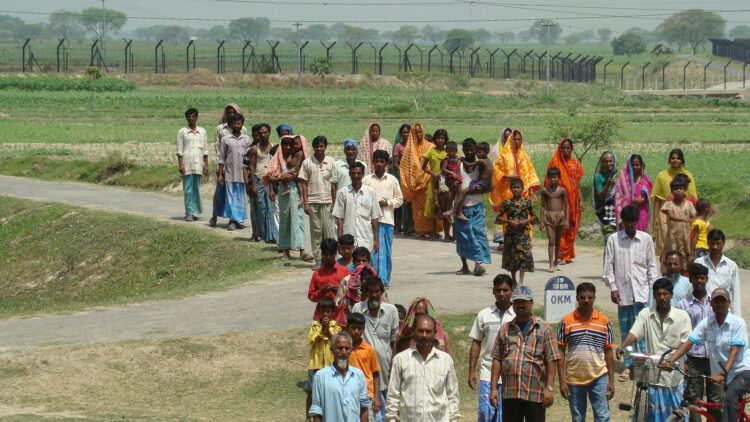
On 26 May 2026, India’s Union Home Minister, Amit Shah announced the constitution of a high-level committee under retired Justice Prakash Prabhakar Naolekar to examine the “unnatural demographic changes” occurring in India due to illegal infiltration and other factors.
While the committee’s focus is on Indian demographic challenges, any serious study of demographic transformation in South Asia must also examine the dramatic changes that have occurred in Pakistan, Bangladesh, and Afghanistan since 1947.
The disappearance and decline of Hindu, Sikh, Buddhist, Jain, and other non-Muslim minority communities from these countries represents one of the most significant yet least discussed demographic transformations of the modern era. Over the last seventy-five years, millions of people have been displaced, persecuted, or forced to migrate, fundamentally altering the social and cultural landscape of the region.
Partition and the Demographic Transformation of Pakistan
The roots of this demographic change lie in the Partition of British India in 1947, one of the largest and bloodiest forced migrations in human history.
According to the 1941 Census, Hindus constituted approximately 14–15 percent of the population in the territories that now form Pakistan, while Sikhs accounted for roughly 6 percent. Together, Hindus and Sikhs represented nearly one-fifth of the population of what became Pakistan. They were economically influential communities, particularly in urban centers of Punjab, Sindh, and the North-West Frontier Province.
However, within a few years, this demographic reality changed dramatically. The communal violence accompanying Partition resulted in mass killings, abductions, and forced displacement on an unprecedented scale. Entire Hindu and Sikh populations of West Punjab, Sindh, and other regions fled to India to escape violence and persecution.
5 million Hindus and Sikhs migrated from West Pakistan to India
Historians estimate that between 4.7 and 5 million Hindus and Sikhs migrated from West Pakistan to India between 1947 and 1951. Estimates of deaths during the Partition violence vary widely, ranging from 200,000 to nearly 2 million people. Regardless of the exact figure, the human suffering was immense and left deep scars on both nations.
As a result, Pakistan’s Hindu population collapsed from around 15 percent before Partition to approximately 1.6 percent by the 1951 Census. The Sikh population, once a major component of Punjab’s society, was virtually eliminated from the country.
Today, Hindus constitute roughly 1–2 percent of Pakistan’s population and are concentrated primarily in Sindh Province. The Sikh population numbers only a few thousand individuals, a tiny remnant of a once vibrant community.
The Gradual Decline of Hindus in East Pakistan and Bangladesh
Unlike West Pakistan, the demographic transformation in East Pakistan (present-day Bangladesh) occurred gradually over several decades.
At the time of Partition, Hindus constituted approximately 28–30 percent of the population of East Bengal. Even after Partition, the first post-independence censuses continued to record a substantial Hindu presence of around 25–26 percent. However, over the following decades, the proportion steadily declined.
Today, Hindus account for less than 8 percent of Bangladesh’s population.
This decline was not the result of a single event but rather the cumulative effect of repeated episodes of violence, discrimination, insecurity, and migration.
The 1950 Riots and Early Migration Waves
The first major post-Partition migration occurred following widespread anti-Hindu riots in 1950.
Violence erupted across several districts, including Dhaka, Barisal, Khulna, and Chittagong. Reports of killings, destruction of property, and intimidation created widespread fear among Hindu communities. As a result, hundreds of thousands of Hindus crossed into India, particularly into West Bengal, Assam, and Tripura.
Throughout the 1950s and early 1960s, periodic communal disturbances and discriminatory practices continued to encourage migration. Many families left not because of a single incident but because of a growing perception that their future in East Pakistan was uncertain.
The Enemy Property Act and Economic Marginalization
One of the most significant factors contributing to Hindu migration was the implementation of discriminatory property laws.
Following the 1965 India-Pakistan War, the Pakistani government enacted the Enemy Property Act. Although presented as a national security measure, the law allowed authorities to confiscate the property of individuals deemed to have migrated to India or suspected of maintaining links with India.
In practice, the law disproportionately affected Hindu families. Many lost agricultural land, homes, businesses, and other assets, severely weakening their economic position.
Property ownership is often the foundation of social security and community stability. The loss of property therefore accelerated migration by making it increasingly difficult for many Hindu families to sustain themselves economically.
Bangladesh’s Vested Property Act
The situation did not substantially improve after Bangladesh achieved independence in 1971.
The successor legislation, known as the Vested Property Act, retained many of the provisions of the earlier Enemy Property Act. Researchers have argued that these laws played a major role in the continued dispossession of Hindu-owned property.
Studies indicate that millions of acres of land were transferred out of Hindu ownership under these legal provisions. Many affected families either migrated to India or chose not to return after temporary displacement.
The economic consequences of these policies were profound and contributed significantly to the long-term demographic decline of the Hindu population.
The 1971 Bangladesh Liberation War
The most devastating assault on the Hindu population of East Pakistan occurred during the Bangladesh Liberation War of 1971.
On 25 March 1971, the Pakistani military launched Operation Searchlight to suppress the Bengali nationalist movement. Numerous contemporary accounts, including those of American Consul General Archer Blood, documented systematic attacks on Bengali civilians.
Hindus were specifically targeted because they were perceived by the Pakistani military establishment as supporters of Bengali nationalism and India.
The scale of violence and the humanitarian catastrophe was immense. The Government of Bangladesh maintains that approximately three million people were killed during the conflict.
By November 1971, nearly ten million refugees had fled into India. The overwhelming majority were Hindus. Although many returned after Bangladesh’s liberation in December 1971, millions chose to remain permanently in India.
This migration permanently altered the demographic composition of several Indian states, particularly West Bengal, Assam, and Tripura.
Dr. Abul Barkat’s Research
One of the most influential studies on this subject was conducted by Bangladeshi economist Abul Barkat of the University of Dhaka.
Based on decades of research, Barkat estimated that approximately 11.3 million Hindus left Bangladesh between 1964 and 2013 due to discrimination, insecurity, and persecution.
According to his calculations, more than 230,000 Hindus left the country annually on average during that period.
His findings suggest that Hindu migration did not end with Bangladesh’s independence. Instead, it continued under successive political governments, reflecting persistent concerns regarding security, property rights, and equal treatment.
The Magnitude of Five Decades of Migration
When these figures are viewed cumulatively, the scale of demographic change becomes clear.
If more than 11 million Hindus left Bangladesh over five decades, this represents one of the largest sustained population movements in modern history. Most migrants settled in India, particularly in West Bengal, Assam, Tripura, Delhi, Maharashtra, Gujarat, and other states.
Economic opportunities, family reunification, and other factors also played a role. Nevertheless, the continuous decline in the Hindu share of the population over many decades strongly suggests that insecurity and discrimination were major contributing factors.
Contemporary Pakistan and Forced Conversions
The situation in Pakistan today differs from that of Bangladesh primarily because the Hindu and Sikh populations had already been drastically reduced during Partition.
Consequently, post-Partition migration occurred in smaller but continuous waves.
Human rights organizations have repeatedly reported cases involving the abduction, forced conversion, and forced marriage of Hindu and Sikh girls, particularly in Sindh and southern Punjab. Such incidents contribute to feelings of vulnerability among minority communities and encourage further migration.
Religious minorities in Pakistan continue to face challenges relating to representation, religious freedom, and social equality.
The Near Disappearance of Sikhs from Pakistan
The experience of Pakistan’s Sikh community deserves special attention.
Before 1947, Sikhs were concentrated in West Punjab and formed a significant social, economic, and cultural force. Many of the region’s agricultural and commercial networks were deeply influenced by Sikh participation.
Partition led to the migration of approximately one to two million Sikhs to India. Today, only a small residual Sikh population remains in Pakistan.
The near disappearance of a community that had shaped Punjab’s history for centuries represents one of the most profound demographic transformations in South Asian history.
Afghanistan’s Forgotten Minorities
Afghanistan presents another example of minority decline.
For centuries, Hindu and Sikh communities played important roles in Afghan commerce and urban life. During the twentieth century, tens of thousands of Hindus and Sikhs lived in cities such as Kabul, Jalalabad, and Kandahar.
However, decades of war, political instability, civil conflict, and the rise of extremist groups triggered a steady exodus. Successive conflicts, including the Soviet invasion, civil war, Taliban rule, and later insurgencies, severely reduced these communities.
Today, only a handful of Hindu and Sikh families remain in Afghanistan, placing these ancient communities on the verge of extinction within the country.
Estimating the Total Migration
When the migrations from Pakistan, Bangladesh, and Afghanistan are considered together, the scale becomes extraordinary.
Approximately 5–7 million Hindus and Sikhs migrated from West Pakistan during and immediately after Partition. More than 11 million Hindus are estimated to have left East Pakistan and Bangladesh since the 1950s. Thousands of Hindus and Sikhs also migrated from Afghanistan during successive waves of conflict.
Taken together, the total number of non-Muslim minorities who migrated to India from these three countries since 1947 may exceed 15–20 million people.
Conclusion
The demographic transformation of Pakistan, Bangladesh, and Afghanistan over the past seventy-five years represents one of the most consequential yet understudied developments in modern South Asian history.
The near disappearance of Hindu and Sikh communities from Pakistan, the continuous decline of the Hindu population in Bangladesh, and the virtual extinction of Hindu and Sikh communities in Afghanistan collectively constitute a major historical phenomenon. These changes were shaped by a complex combination of Partition violence, communal tensions, discriminatory laws, economic marginalization, insecurity, political instability, and migration.
Understanding this history is important not only for demographic research but also for broader discussions on minority rights, religious freedom, refugee movements, and regional stability. The experience of these communities deserves greater scholarly attention and international awareness, as it represents a significant chapter in the modern history of South Asia that should neither be ignored nor forgotten.
Top of Form
Bottom of Form