Synopsis : President Trump has launched war in Iran much against the MAGA slogan and his own projected image of a peace-maker in the world . While destruction of the nuclear facilities in Iran is the declared objective, it appears to be more for Netanyahu to boost his political image while struggling to continue as Prime Minister leading a minority coalition in a country where the public opinion is largely against Iran . USA knows from past experience that it will be almost impossible to win a war in Asia and yet President Trump engaged USA in this war without a clear endgame plan . USA and Israel together have inflicted colossal material damages in Iran putting thousands of Iranians in a miserable situation . However , it is not likely that the Iranian Govt will surrender as demanded by President Trump . A prolonged war could ultimately compel USA to withdraw without achieving the objectives as was the case in earlier wars in Asia . Lasting peace in the Middle east is possible only if the nations in the region reconcile to the reality that they have to live together without external interference in spite of their differing perspectives . The deal between Iran and Saudi Arabia made in 2023 was in the right direction and this has to be extended to other countries . The belligerence of Israel will have to come to an end with a mutually acceptable solution for Palestinian issue .Israel has no choice but to work out a deal with Iran for peaceful coexistence . USA will not have any oil-interest in the region and is likely to withdraw its military bases from the Middle east . Contrary to the public statements , USA will have an interest in striking a deal with Iran for taking advantage of the “ Persian corridor “ for having a land-route from the Arabian sea to the Central Asia for exploiting the enormous mineral wealth in the region . I hope that wisdom will prevail and the war will come to an end sooner than later . Middle East nations will have to find a new equilibrium for living together recognizing their common destiny . Iran with its strategic geopolitical situation as the land-link between Arabian sea/ Persian gulf and Central Asia will be a dominant nation courted by USA, Europe and several Asian countries .
1.Introduction
Although American decision-makers are generally known to have strategic thinking , they are also capable of taking snap-decisions with disastrous consequences for their nation . The American adventure in Vietnam , Iraq and Afghanistan are the clearest examples. Iran could be yet another example if war prolongs for the wrong reasons and if Americans try to subjugate a proud nation like Iran .
| War | Period | Casualties | Remarks |
| Vietnam war | 1955-1975 | 58200 soldiers killed | Total failure to meet objectives, loss of prestige ( see note ) |
| Iraq war | 2003-2011 | 4400 soldiers killed | Rise of extremism, loss of credibility , Rise of Iran as a regional power. |
| Afghan war | 2001-2021 | 2400 soldiers killed | Total failure , Chaotic withdrawal |
| Iran war | 2026- ? | ? | ? ( see note 2 ) |
Note 1 : In view of the disastrous consequences of the Vietnam war , the Congress passed the War Powers Act 1973 so as to put constraints on presidents to go for war with other countries . In spite of the war Power Act 1973, President Trump started the Iran war without approval from the Congress. Some of the Republican Senators supporting President Trump are trying to project the Iran war simply as an action and not as a war .
Note 2 : USA has not yet announced the objectives of the war in clear terms or the end-game plan . Contradicting comments from White House give an impression of lack of clarity of objectives . In a sense , this ambiguity may help President Trump to declare victory and withdraw from Iran war or perhaps even from the Middle East leaving the region into a situation of uncertainty as was the case after the US withdrawal from Iraq.
- US- Iran relations since Second World War
Iran was a constitutional monarchy in 1950 under Mohammed Reza Phalavi Shah. However , there was a strong public movement for embracing a democratic system under the leadership of Mohammed Mossadegh of National Front party . His party could form a minority Govt with him as Prime Minister . in line with his election promise, he nationalized the oil industry in 1951 against British interest . Britain and USA together successfully manipulated a coup in 1953 to overthrow Mossadegh . Iran could have been a prospering democracy now if the US had not sided with Britain to overthrow Mossadegh. US Supreme Court Justice William Douglas tried his best to get support for Mossadegh from US Govt without success and his public statement in 1965 given below shows his frustration .
“ Mossadegh tried to introduce democracy for the first time into Iran’s villages whose government had been “crushed. We united with the British wanted to destroy him and we succeeded. Ever since, our name has not been an honored one in Iran .
How prophetic his observations were !!!
Shah of Iran appointed General Zehadi as Prime Minister and put Mossadegh under house arrest till his death . Thereafter Iran became a subservient ally of USA . Shah maintained a cordial relation with Israel . USA turned a blind eye to the oppressive regime of Shah of Iran and the country plunged into social unrest. USA had the possibility to correct Shaw for adopting a pro-people policy. Instead , CIA and Mossad helped Shaw’s secret service organization Savak to perpetuate oppressive actions . The Islamist fundamentalists exploited the general resentment of people for increasing their influence in the Iranian society . US Ambassador Sullivan could have persuaded Shaw to deal with the population differently for preventing the takeover the country by Islamist fundamentalists . Finally Shah had to flee and Ayatollah Khomeini came back from France in 1979 to take charge . He declared Iran as an Islamic Republic. Very soon, Iraq attacked Iran with the support of USA in the pretext of territorial disputes and almost all the Arab countries in the region except Syria and Libya which supported Iran . Israel supported Iran clandestinely . War ended without a winner but with huge losses for both the countries . In short, USA considered Iran as a hostile nation ever since Shah was deposed and it continues to be so even now .
- Iran’s nuclear ambitions
Iran started its nuclear programme called “ atoms for peace “ in 1957 with the signature of a nuclear cooperation agreement with USA . The programme was expanded to include projects for nuclear power generation as well as for developing nuclear fuel cycle with enrichment of uranium . Iran did sign and ratify the Nuclear Non-proliferation treaty in 1970 .USA became suspicious about Iran’s nuclear activities after the Islamic republic took over power and wanted Iran to stop further nuclear activities . Iran refused and Israel came out with an exaggerated existential threat from Iran’s nuclear weapons . Provocative statements of Iranian President Ahmadinejad added fuel to the fire in an already deteriorating relation between Israel and Iran . With the signature of Joint Comprehensive Plan of action between Iran and P5+1, it was believed that the matter was under control . EU and USA had been planning to have access from Arabian sea/ Persian gulf to the Central Asia through the Persian Corridor with the establishment of a stable situation in Iran . President Trump unilaterally withdrew from the agreement in 2018 and the subsequent events have resulted in the current crisis .
- The Persian Corridor .
USA knew the importance of Persian corridor ( Persian Gulf to Russia ) because US had used this corridor extensively during the Second World War. After the Soviet Union joined the Allies in 1941 for the war against Germany , the Persian corridor connecting the Persian Gulf to the Soviet Union through the Trans-Iranian Railway network was widely used for the supply of US equipment to Russia under the “ Lend Lease “ arrangement . This corridor is modernized with the help of India as International North South Transport Corridor connecting India and Russia through a multimodal transport system . A land route from Iran to the Mediterranean coast through Iraq and Syria will alsobe possible if peaceful conditions exist in the Middle East . If Israel is able to establish friendly relations with the neighbouring oil producing countries including Iran, the Eilat-Ashkelon pipeline passing through Israel connecting Red Sea and the Mediterranean sea constructed during Shaw’s regime also could be put in operation for transporting crude . Connecting Central Asia and Europe through a land route is of great importance to Europe . Every geopolitical strategist knows the importance of Iran’s geographical location and USA will be the biggest beneficiary to have good working relations with Iran . .
5.Probable Outcome of the war
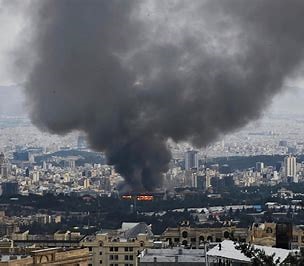
It is obvious that the US operation in Iran will cause considerable damage to the infrastructure in Iran, thousands of deaths of innocent people , miserable economic conditions for millions of Iranians with the United nations remaining a silent and helpless spectator in total contravention to its set-objectives. Once again, the famous Melian message of Greek historian Thucydides that “ the strong do what they can and the weak suffer what they must “is clearly visible in US action . Following questions would need reflection :
a)Will US be able to extract unconditional surrender from Iran so as to set up a puppet-regime in Iran ? . The answer is likely to be NO
- b) Will USA be able to destroy Iran’s nuclear capabilities ? . The answer is likely to be NO. , Iran will be able to rebuild the facilities even if US succeeds in destroying some of the nuclear facilities of Iran.
- c) Will US be able to have a regime change in Iran ? . The answer could be NO . However , people of Iran may force the regime to have a new approach giving freedom of expression .
- d) Majority of the nations in the Middle east know that they have to live together with their neighbours without interfering into the affairs of others . it was in this background Oman and China together facilitated a discussion between Iran and Saudi Arabia in 2023. It will be necessary to bring Israel also into the group for ensuring peace in the region .
- e) Will US continue to have oil interest in the region ? . The answer is NO . A stable and peaceful Middle East History shows without any ambiguity that Britain and France who managed the Middle East under mandates after the first world war left the region in total disarray after the Second World War. Creation of Transjordan , Lebanon and Kuwait as separate countries, creation of Saudi Arabia and making Sharif Hussein bin Ali of Hejaz a weak leader, unscientific settlement border between Iraq and Iran , division of Palestine into two countries were all actions for perpetuating instability in the region for multiple reasons . Presence of UK and USA in the regions for exploiting the oil-wealth was also a contributory factor which created tension in the region .
Middle East the birthplace of Judaism, Christianity and Islam and it should be possible for people belonging to these religions ( including sub divisions ) to live in peace in the region. The 14 countries in the Middle East together have a population of around 303 million ( 2026 data ). It is true that the population in this region is predominantly Muslims (124 million Sunni Muslims and 106 million Shia Muslims) . A peaceful co-existence of these Muslims with a workable relation with Jews and Christians is an absolute necessity for ensuring harmony and peace in the Middle East .
- Conclusion
- a) It is a fact that USA and Iran were engaged in discussions mediated by Oman for coming to an agreement on Iran’s nuclear programmes . An attack on Iran for assassinating the Supreme Leader was a highly provocative act by Israel . USA should have persuaded Israel to have restraint . There was really no reason to have a war in the Middle East now
- b) Direct entry of USA in the conflict is unfortunate and was avoidable . It was against the declared policies of President Trump .
- c) UN showed once again that it is incapable to deal with the Permanent members of UNSC.
- d) USA should take the initiatives to bring Iran and Israel to the negotiating table and work out a solution without prolonging the war .
- e) There will be no winner in this war . Earlier it ends better it will be for all . US entry into the war could be yet another act of adventurism . In spite of several setbacks in launching war in Asia , the Americans have not yet understood the mindset of Asians and continue to think that anybody and everybody can be subjugated with brutal power. It is, in fact , this lack of understanding which may lead USA to another adventurism in Asia in Iran
- f) The future of the Middle East will have to be built with the participation of all the nations in the Middle East for ensuring peace and prosperity for all by creating a geographical space where people of all religions live in harmony .
- g) Iran is the most populous country in the region and will be a country to reckon with under any scenario of a peaceful Middle East . Its strategic geopolitical importance as a land link between The Arabian Sea and the Central Asia is an unquestionable advantage .
C.M.A.Nayar
Trivandrum, Kerala , India
10th March 2026