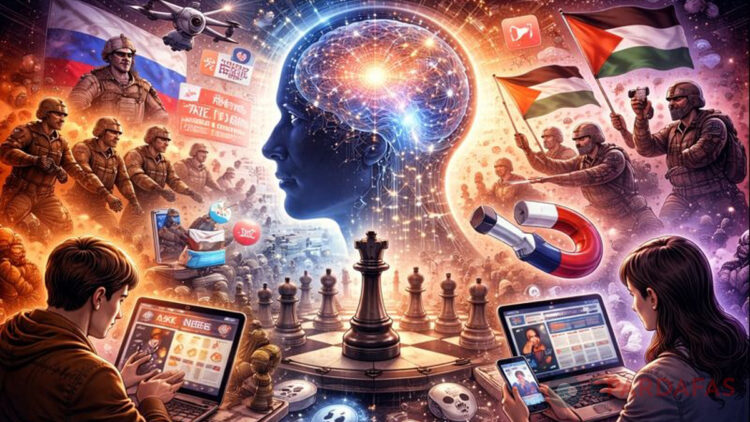
Bharat’s adversaries, China, Pakistan, the Deep State, and elements within the Western world who dislike Bharat’s progress, along with their operatives inside Bharat, are misusing social media to wage Cognitive Warfare, Narrative Warfare, and Information Warfare against Bharat.
Social media has become the primary source of information for today’s youth. Many young people consume information from Instagram Reels, YouTube Shorts, WhatsApp forwards, or influencer videos rather than newspapers or television.
The issue is that social media platform algorithms do not seek the truth; they push content that captures people’s attention. Consequently, content that triggers anger, fear, shock, or hatred spreads much faster.
This leads to the following consequences:
- Increased societal polarization.
- Mutual suspicion among people.
- Erosion of trust in institutions.
- Strengthening of radical ideologies.
- Weakening of democratic discourse.
These are referred to as the harmful effects of the “Attention Economy.” In the information economy, the scarce resource is your attention.
Every minute you spend on a platform increases opportunities for advertising, data collection/gathering intelligence, and engagement.
Indian Youth: The Biggest Target
Nearly half of Bharat’s population is under 35 years of age. As a result, Indian youth are the primary target in information war by the inimical forces.
Through online gaming, social media, influencer culture, entertainment, and digital advertising, young minds can be influenced. These influences are not always political; they can also be cultural, social, or economic.
At times, youth unwittingly forward misinformation. Information is frequently made viral without verifying whether it is true or false.
In such a scenario, every young person can be both a potential soldier and a potential target in information warfare.
Impact on National Security
In future wars, the enemy will not need to attack Bharat’s borders directly. They can generate mistrust, instability, and division within Indian society itself.
Using false information:
- Communal riots can be incited.
- Elections can be influenced.
- Economic panic can be created.
- The morale of the armed forces or can be impacted.
- Trust in the government can be undermined.
Because of this, national security is no longer confined to border defense; it is deeply linked to information, psychology, and social cohesion.
The New Battlefield Against Bharat
The nature of warfare in the 21st century is changing rapidly. Previously, winning a war required armies, drones, and missiles. Today, instilling doubt, mistrust, fear, and confusion in the minds of a country’s citizens has become a highly effective weapon. This is known as Cognitive Warfare or Narrative Warfare.
In a large democracy like Bharat, this warfare can be especially dangerous. Bharat has over 900 million internet users, diverse languages, various religions, castes, regional identities, and highly active political discourse. This makes Bharat an attractive target for information warfare.
In the context of conflicts in West Asia, alleged videos of senior Indian leaders and officials circulated on social media, were later found to be artificially generated. Such incidents can mislead millions of people within hours or minutes.
According to an ORF study, Bharat is among the countries most vulnerable to AI-generated misleading information. The incidence of AI-based fraud, voice cloning, and deepfakes is rising rapidly.
Towards an Indian National Cognitive Security Architecture
Just as Bharat developed a comprehensive approach to cybersecurity after recognizing digital threats, it must now develop an integrated Cognitive Security Architecture to counter deepfakes, information warfare, and psychological influence operations.
Establish a National Cognitive Security Centre
Bharat should establish a National Cognitive Security Centre under the National Security Council Secretariat or a similar strategic body.
Its responsibilities could include:
- Monitoring cognitive warfare threats.
- Tracking foreign influence operations.
- Identifying deepfake campaigns.
- Coordinating inter-agency responses.
- Conducting strategic assessments.
This institution would function as the country’s central node for cognitive security.
Create a National Deepfake Early Warning System
Bharat requires a nationwide mechanism capable of detecting and flagging deepfake content in near real time.
Such a system should integrate:
- Artificial intelligence tools.
- Social media monitoring.
- Open-source intelligence.
- Fact-checking networks.
- Cybersecurity agencies.
Early detection can prevent misinformation from achieving strategic impact.
Integrate Cognitive Security into National Security Planning
At present, cyber security receives significant attention within national security frameworks. Cognitive security should receive similar recognition.
Military planners, intelligence agencies, and policymakers must consider:
- Narrative warfare.
- Information operations.
- Social media influence campaigns.
- Deepfake-enabled deception.
- Psychological manipulation.
These factors should be incorporated into national threat assessments and strategic planning exercises.
Strengthen Digital Literacy and Public Awareness
The first line of defence against cognitive warfare is an informed citizenry. Digital literacy must be made a mandatory part of education starting from the school and college levels. Students should be trained on how to verify information, spot deepfake videos, understand how social media algorithms work, and recognize the psychology behind online propaganda campaigns.
Bharat should introduce structured digital literacy programs that teach citizens:
- How to identify deepfakes.
- How to verify information sources.
- How algorithms influence perceptions.
- How misinformation spreads online.
Such education should begin in schools and continue through higher education and public awareness campaigns.
Build Public-Private Partnerships
Technology companies possess significant expertise and data regarding online influence operations.
Bharat should establish institutional partnerships among:
- Government agencies.
- Social media platforms.
- AI companies.
- Universities.
- Media organizations.
Other Measures
- Indigenous AI Tools: Bharat needs to invest heavily in developing indigenous AI tools to detect deepfakes and AI-driven misinformation. Under the Union Government’s Bharat AI Mission, several projects to detect deepfakes have been launched across IITs and other institutions; such efforts must be expanded.
- Multi-lingual Fact-Checking: Fact-checking mechanisms must be developed across all major Indian languages, not just English or Hindi, but also Marathi, Tamil, Bengali, Assamese, Malayalam, Kannada, and others.
- Rapid Government Communication: During national crises such as border disputes, terrorist attacks, communal tensions, or natural disasters, the government must deliver fast, accurate, and reliable information to citizens. An information vacuum fuels rumours and propaganda.
- Platform Accountability: Social media platforms must be made more transparent and accountable regarding their algorithms, content recommendation systems, and deepfake material. Bharat has already implemented rules regarding digital platform responsibility and is promoting measures like labelling and metadata for AI-generated content.
- Integrated Cybersecurity: Cybersecurity and cognitive security should be integrated and treated as core components of national security. Today’s enemy does not merely attack computer systems; they attempt to influence the minds of citizens and society’s collective thinking.
- Cross-Sector Coordination: Coordination must be enhanced among the armed forces, intelligence agencies, academia, the tech industry, and media organizations.
A coordinated national approach is essential because cognitive warfare affects multiple sectors simultaneously.
Promote Positive National Narratives
Defensive measures alone are insufficient.
Bharat must also proactively promote fact-based, positive, and credible narratives highlighting achievements in science, technology, defence, entrepreneurship, sports, and social innovation.
A confident and well-informed society is inherently more resistant to hostile influence campaigns.
Propaganda cannot be countered by censorship alone; it requires truth, credibility, national self-confidence, and an aware citizenry. In this new era of cognitive warfare, Bharat’s greatest strength lies in creating an educated, information-conscious, and nationally aware civil society.
Conclusion
In 21st-century warfare, information, narratives, and control over human minds have become just as vital as armies and soldiers. Adversaries like China Pakistan and many in western world are continuously investing in this domain. Therefore, Bharat must adopt “Cognitive Security” as the new frontier of national security.
The outcome of future wars will not be decided solely on the physical battlefield; it will also be determined in the minds of citizens, on mobile screens, and within the flow of digital information. Conscious citizens, responsible media, robust technology, and national unity will serve as Bharat’s most effective protective shield.