Indus Research
No Result
View All Result
Monday, May 11, 2026
login
  • Home
  • About
    • Who We Are
    • Patrons
    • Governing Board
    • Advisors
    • Directors
    • Editorial Board
    • Support IIRF
  • Themes
    • International Relations & Security
      • Land Security
      • Maritime Security
      • Aerospace Security
      • Nuclear
      • Geopolitics
    • History
    • Military Doctrine & Strategy
      • Doctrines
      • Joint and Integrated Defence
      • Civil Military Relations
    • Science and Technology
      • Defence Technology
      • Industries and Society
      • Climate Change
      • Natural Resources
    • Economics and Commerce
      • Rare Earth
      • Maritime Economy
      • International Trade
    • Education
  • Focus Geographies
    • South Asian Connectivity & Cooperation
      • Afghanistan
      • Pakistan
      • Nepal
      • Bhutan
      • Bangladesh
      • Myanmar
      • Sri Lanka
      • Maldives
      • BIMSTEC
      • SAARC
      • SAGQ
      • BBIN
      • BRI
      • INSTC
      • IORA
      • MGC
      • IMT
    • Indo-Pacific
      • Indo-Pacific Economic Forum
      • QUAD
      • Oceania
      • IORA
      • Middle East
    • Indo-US Relations
    • Central Asia and Russia
  • Publications
    • Commentary
    • Issue Briefs
    • Research Paper
    • Monograph
    • Journal Articles
    • Books
    • Book reviews
    • Contributors
    • Submission Rules
    • IIRF Strategic Year Book – 2022-23
    • IIRF Strategic Yearbook – 2024
  • Membership
    • Membership Form
  • Indo-US Forum
  • Indian Knowledge System
    • Arts & Culture
    • Yoga & Health
    • Sanskrit Vedic Science Spirituality
  • IIRF Creativity Zone
  • Contact
  • Events & Media
    • IIRF EVENTS
    • US-India Business Connect 2025
    • WTC Utah’s India Trade Mission 2024 Gallery
    • Videos
  • language
    • Hindi
  • Home
  • About
    • Who We Are
    • Patrons
    • Governing Board
    • Advisors
    • Directors
    • Editorial Board
    • Support IIRF
  • Themes
    • International Relations & Security
      • Land Security
      • Maritime Security
      • Aerospace Security
      • Nuclear
      • Geopolitics
    • History
    • Military Doctrine & Strategy
      • Doctrines
      • Joint and Integrated Defence
      • Civil Military Relations
    • Science and Technology
      • Defence Technology
      • Industries and Society
      • Climate Change
      • Natural Resources
    • Economics and Commerce
      • Rare Earth
      • Maritime Economy
      • International Trade
    • Education
  • Focus Geographies
    • South Asian Connectivity & Cooperation
      • Afghanistan
      • Pakistan
      • Nepal
      • Bhutan
      • Bangladesh
      • Myanmar
      • Sri Lanka
      • Maldives
      • BIMSTEC
      • SAARC
      • SAGQ
      • BBIN
      • BRI
      • INSTC
      • IORA
      • MGC
      • IMT
    • Indo-Pacific
      • Indo-Pacific Economic Forum
      • QUAD
      • Oceania
      • IORA
      • Middle East
    • Indo-US Relations
    • Central Asia and Russia
  • Publications
    • Commentary
    • Issue Briefs
    • Research Paper
    • Monograph
    • Journal Articles
    • Books
    • Book reviews
    • Contributors
    • Submission Rules
    • IIRF Strategic Year Book – 2022-23
    • IIRF Strategic Yearbook – 2024
  • Membership
    • Membership Form
  • Indo-US Forum
  • Indian Knowledge System
    • Arts & Culture
    • Yoga & Health
    • Sanskrit Vedic Science Spirituality
  • IIRF Creativity Zone
  • Contact
  • Events & Media
    • IIRF EVENTS
    • US-India Business Connect 2025
    • WTC Utah’s India Trade Mission 2024 Gallery
    • Videos
  • language
    • Hindi
No Result
View All Result
Indus Research
No Result
View All Result
Home Book reviews

Book Review The Four Ages Of American Foreign Policy Weak Power, Great Power, Superpower, Hyperpower (by Air Marshal Anil Khosla)

by Air Marshal Anil Khosla
November 19, 2024
in Book reviews, Central Asia and Russia, Commentary, Geopolitics, HISTORY, Indo-US Relations, International Relations & Security
0
Book Review   The Four Ages Of American Foreign Policy Weak Power, Great Power, Superpower, Hyperpower (by Air Marshal Anil Khosla)
Total
0
Shares
Share 0
Tweet 0
Share 0
Share 0
Share 0

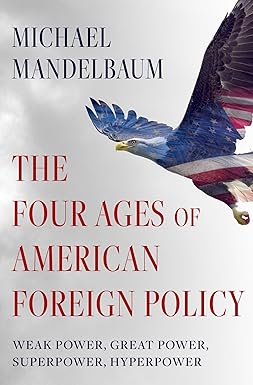
Michael Mandelbaum’s The Four Ages of American Foreign Policy offers a sweeping examination of the United States’ transformation from a fledgling nation into a hyperpower that dominates the global stage. By examining over two centuries of American history, Mandelbaum classifies U.S. foreign policy into four primary “ages,” each representing a distinct growth phase and influence in international affairs. The book dives into the evolution of American strategy and intent in foreign relations, framing each “age” as a response to shifting global circumstances and reflecting the country’s unique political culture. By dividing the country’s history into weak power, great power, superpower, and hyperpower, Mandelbaum provides a framework for understanding how the U.S. has adapted its policies to meet the changing needs of each era.

Mandelbaum’s narrative opens with the Weak Power era (1776–1865), during which America primarily focused on survival and independence rather than international ambitions. The young nation was more concerned with establishing a stable government and defending its sovereignty than projecting power abroad. This era was marked by the emphasis on avoiding European entanglements, which is evident in policies like George Washington’s Farewell Address, which urged against permanent alliances, and Thomas Jefferson’s expansion-oriented Monroe Doctrine. Mandelbaum highlights that during this period, the U.S. was relatively powerless in global affairs, focused on creating a continental nation and avoiding conflicts that could threaten its security and stability.

However, as the United States expanded westward and industrialised, it grew in strength and influence, eventually emerging as a Great Power (1865–1945). This era, Mandelbaum argues, was defined by America’s transition from a primarily inward-focused power to an increasingly assertive global player. Following the Civil War, the U.S. embraced a more interventionist stance, particularly in the Western Hemisphere, solidifying its presence through events like the Spanish-American War and the subsequent acquisition of overseas territories, including Puerto Rico, Guam, and the Philippines. Mandelbaum examines how the U.S. began to assert influence beyond its borders, adopting a broader vision of its role in the Western Hemisphere and, later, in the First World War, as a global moral leader. Although hesitant to join the League of Nations after World War I, America’s involvement in the war indicated a shifting sense of responsibility for world affairs.

The author provides a nuanced examination of the Superpower era (1945–1991), marked by the Cold War rivalry with the Soviet Union. This era saw the U.S. and Soviet Union engage in a multi-decade ideological struggle, where each superpower sought to assert the dominance of its political and economic systems across the globe. Mandelbaum explains that American foreign policy during this time was driven by the doctrine of containment, which focused on limiting the spread of communism and Soviet influence. Key policies of this era included the Truman Doctrine, which pledged U.S. support for nations resisting communist subjugation, and the Marshall Plan, a bold investment to help rebuild European economies while staving off Soviet influence. Mandelbaum argues that the U.S.’s superpower status during the Cold War allowed it to shape international institutions and norms in unprecedented ways, often dictating the terms of global security and economic stability.

However, the Cold War’s end and the Soviet Union’s collapse in 1991 heralded the onset of the Hyperpower era (1991–Present). Mandelbaum characterises this period as one of unparalleled dominance by the United States, as it stood as the world’s only remaining superpower. American influence permeated nearly every aspect of international relations in this new global reality. The U.S. was not just a powerful nation but, for a time, an almost uncontested force that set the agenda in international politics, economics, and culture. However, Mandelbaum is careful to note the challenges of this hyperpower era. Though the U.S. achieved a level of influence unmatched in world history, it has also faced significant struggles in this role. Post-9/11 conflicts in the Middle East, particularly the wars in Afghanistan and Iraq, have been costly and complex, challenging America’s perception as a stabilising force. Mandelbaum argues that despite America’s overwhelming military and economic advantages, the hyperpower era has exposed limitations in achieving long-term stability through military interventions alone.

Mandelbaum’s The Four Ages of American Foreign Policy excels in its ability to contextualise complex foreign policy decisions within each era’s historical trends and pressures. By categorising U.S. foreign policy into these distinct “ages,” he provides a framework for understanding the ebb and flow of American influence as it adapts to an ever-changing international landscape. Throughout the book, Mandelbaum offers detailed analyses of significant policies, such as the Marshall Plan, NATO, and the recent “War on Terror,” examining how each has shaped the global order and influenced the U.S.’s position.

A significant strength of Mandelbaum’s book is his exploration of the interplay between American ideals and strategic interests. For instance, he discusses how the nation’s commitment to democracy and capitalism influenced its actions during the Cold War, balancing the moral impetus to protect freedom with the pragmatic need to counter Soviet influence. Mandelbaum also addresses the ideological basis of American foreign policy, reflecting on the country’s self-image as a “city upon a hill” and the belief in its mission to spread freedom and democracy. He explains how this ideology has fuelled foreign policy initiatives while creating tensions and inconsistencies—particularly when U.S. actions abroad have conflicted with its professed values.

The Four Ages of American Foreign Policy is compelling and informative. Mandelbaum’s historical perspective provides readers with a roadmap to understand how and why the United States has occupied such a central role on the world stage and how its position has changed over time. By framing U.S. foreign policy within the distinct categories of weak power, great power, superpower, and hyperpower, Mandelbaum offers a lens through which readers can analyse current American foreign policy, equipped with the historical context needed to understand its complexities.

The Four Ages of American Foreign Policy is essential for anyone interested in the history and future of American influence in global affairs. Mandelbaum’s clear, insightful writing and well-structured approach make the book accessible to foreign policy students and general readers. This work reminds us that while America has achieved great influence, it also bears significant responsibilities and must continuously adapt to maintain its role in a changing world.




Total
0
Shares
Share 0
Tweet 0
Pin it 0
Share 0
Share 0

Leave a Reply Cancel reply

Your email address will not be published. Required fields are marked *

Recent Posts

BREAKING GLASS CEILING – Col Vijaykant Chenji (Retd)

BREAKING GLASS CEILING – Col Vijaykant Chenji (Retd)

April 21, 2026
Lessons For India: Learning From USA-Iran War – by Brigadier Hemant Mahajan (Retd)

Lessons For India: Learning From USA-Iran War – by Brigadier Hemant Mahajan (Retd)

April 21, 2026
WAR WITHOUT FRONTIERS : How Modern Conflict is Redefining Victory  – by Col Vijay Chenji (Retd)

WAR WITHOUT FRONTIERS : How Modern Conflict is Redefining Victory – by Col Vijay Chenji (Retd)

April 5, 2026
Naval Confrontation in the Strait of Hormuz: American Aircraft Carriers vs Iran’s ‘Choke-Point’ Strategy – by Brigadier Hemant Mahajan

Naval Confrontation in the Strait of Hormuz: American Aircraft Carriers vs Iran’s ‘Choke-Point’ Strategy – by Brigadier Hemant Mahajan

April 4, 2026
From NATO to a New Security Structure in Europe – By C.M.A.Nayar

From NATO to a New Security Structure in Europe – By C.M.A.Nayar

March 31, 2026
Trump’s endgame: Could Israel bear the brunt of Iran conflict? – by Lt Gen C.A. Krishnan (retd)

Trump’s endgame: Could Israel bear the brunt of Iran conflict? – by Lt Gen C.A. Krishnan (retd)

March 24, 2026

<strong>About IIRF</strong>

Indus International Research Foundation is a New Delhi based organisation with its overseas centre at USA . It is part of a global network of scholars, professionals and veterans based in India and abroad. The Foundation focuses primarily on international relations, Indian heritage, political economy and security studies. Led by experts with decades of international and domestic policy experience, IIRF India engages with governments, policymakers, academics, students, industries, practitioners, and civil society to provide insightful and fresh analysis of global trends and India’s challenging role as an emerging world leader. Foundation also runs special programs for veterans.

Office Addresses

Delhi NCR
F-511, Jalvayu Towers, Sector-47, Noida, Gautam Budh Nagar, UP, India – 201301
Email – contact@indusresearch.in
Mobile :- +91 8588021407

USA
India International Research Foundation, 2105 Long Park Avenue Prosper 75078, Dallas, Texas, USA Email – infousa@indusresearch.in

Bangalore
Indus International Research Foundation, Parkside Brigade Orchards, Devanhalli, Bangalore, Karnataka -562110

Explore IIRF

  • Links
  • International Relations & Security
  • History
  • Military Doctrine & Strategy
  • Science and Technology
  • Economics and Commerce
  • Education
  • IIRF Creativity Zone
  • Membership
  • Support IIRF

© 2022 Indus Research

No Result
View All Result
  • Home
  • About
    • Who We Are
    • Patrons
    • Governing Board
    • Advisors
    • Directors
    • Editorial Board
    • Support IIRF
  • Themes
    • International Relations & Security
      • Land Security
      • Maritime Security
      • Aerospace Security
      • Nuclear
      • Geopolitics
    • History
    • Military Doctrine & Strategy
      • Doctrines
      • Joint and Integrated Defence
      • Civil Military Relations
    • Science and Technology
      • Defence Technology
      • Industries and Society
      • Climate Change
      • Natural Resources
    • Economics and Commerce
      • Rare Earth
      • Maritime Economy
      • International Trade
    • Education
  • Focus Geographies
    • South Asian Connectivity & Cooperation
      • Afghanistan
      • Pakistan
      • Nepal
      • Bhutan
      • Bangladesh
      • Myanmar
      • Sri Lanka
      • Maldives
      • BIMSTEC
      • SAARC
      • SAGQ
      • BBIN
      • BRI
      • INSTC
      • IORA
      • MGC
      • IMT
    • Indo-Pacific
      • Indo-Pacific Economic Forum
      • QUAD
      • Oceania
      • IORA
      • Middle East
    • Indo-US Relations
    • Central Asia and Russia
  • Publications
    • Commentary
    • Issue Briefs
    • Research Paper
    • Monograph
    • Journal Articles
    • Books
    • Book reviews
    • Contributors
    • Submission Rules
    • IIRF Strategic Year Book – 2022-23
    • IIRF Strategic Yearbook – 2024
  • Membership
    • Membership Form
  • Indo-US Forum
  • Indian Knowledge System
    • Arts & Culture
    • Yoga & Health
    • Sanskrit Vedic Science Spirituality
  • IIRF Creativity Zone
  • Contact
  • Events & Media
    • IIRF EVENTS
    • US-India Business Connect 2025
    • WTC Utah’s India Trade Mission 2024 Gallery
    • Videos
  • language
    • Hindi

© 2022 Indus Research