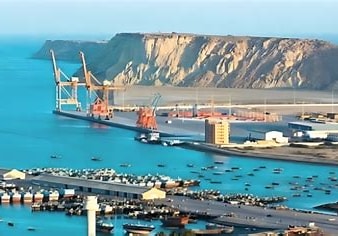
“Gwadar is viewed as a critical pearl in China’s maritime strategy as it would give a permanent logistical footprint near an important choke point — the Strait of Hormuz and the oil rich Persian Gulf, explains Commodore Venugopal Menon (retd).”
Key Points
Gwadar remains primarily a commercial port despite persistent speculation regarding future Chinese military basing ambitions.
Limited cargo volumes, weak connectivity, security concerns and local opposition continue to hamper commercial viability.
China views Gwadar as a strategic foothold near the Strait of Hormuz and critical energy routes.
Plans for overland oil transport to Xinjiang remain largely unrealised due to terrain and economic constraints.
Security threats, geopolitical sensitivities and infrastructure gaps complicate any future militarisation of the port.
Speculation on the strategic dual-purpose port at Gwadar including a Chinese military base has been a hot topic for defense analysts.
Although, there has been significant development in the setting up of a commercial port infrastructure at Gwadar, there is no confirmation on the envisaged plans for a military base at Pakistan’s Gwadar port.
While the crucial deep-water port is a Chinese funded and operated hub within the China Pakistan Economic Corridor (CPEC), its function remains primarily commercial currently with a limited scope for dual use capabilities that could support naval operations in future.
Current Status: Infrastructure
Port Infrastructure : The port is managed by the Chinese Overseas Port Holding Company. The port has a natural depth of 14.5 M capable of accommodating large and deep draft ships up to 70000 DWT. Port features nine multipurpose berths with a highly developed cargo terminal zone to facilitate global shipping. A sprawling 60-hectare free zone designed for manufacturing, warehousing and export processing supports the port operations. Commercial facility also offers premium office spaces for international investors and maritime logistics operators.
Connectivity and Logistics
Eastbay Expressway : A dedicated six lane corridor connects the port free zones to the Makhran coastal highway to ensure smooth cargo movement. Integrated Sea Air Logistics : Advanced infrastructure links the port to the new Gwadar international airport. Warehousing Hubs :Dedicated logistics and warehousing parks are operational to support regional trade distribution.
A Scorecard on performance of Gwadar Port
Gwadar port is not yet commercially successful as envisaged. Despite its strategic location and billions of dollars Chinese investments as part of the CPEC, the port has struggled to attract major shipping lines. The port handles only a fraction of the cargo processed by established ports such as Karachi. Reasons for the poor performance could be surmised as follows:
Limited Commercial Activity
The port handles very little cargo compared to expectations. It handles far fewer ships per year than other regional ports and has failed to attract major shipping lines.
Macroeconomic Challenges
Gwadar free zone remains underdeveloped and supporting infrastructure has not kept in pace with the development of the port. Connectivity within the country has also been a weak area.
Local and Regional Issues
The development has faced friction with the local Baluchistan population. Related mega projects such as the newly constructed Gwadar International airport are currently underutilised due to a lack of passenger and commercial demand which compounds to the poor performance of the port.
Security Presence
Although there is no formal military base, China’s military maintain a physical presence including a highly fortified and exclusive barracks for security personnel guarding Chinese nationals at the CPEC infrastructure.
Strategic Dimension
Geopolitical angle : Gwadar is viewed as a critical pearl in China’s maritime strategy as it would give a permanent logistical footprint near an important choke point — the Strait of Hormuz and the oil rich Persian Gulf. The importance of the Strait of Hormuz needs no emphasis as demonstrated by the US Iran conflict. The blockade of the Strait of Hormuz by the US and Iran severely affected the smooth flow of shipping and nearly crippled the global economy in addition to raising energy security concerns of countries in South Asia, South East Asia and the Far East.
How does China benefit from this investment?
The premise was that a base at the deep-water port of Gwadar would offer China critical strategic and economic advantages. More importantly it would provide a crucial exit to the ocean just 400 km from the strait of Hormuz, allowing Chinese seaborne cargo to bypass the long passage through the Indian Ocean, the South China Sea and the Strait of Malacca as per the initial Chinese assessment. The envisaged operationalisation of the CPEC was expected to reduce the existing 12,000 km journey for oil transportation to roughly 2400km which could have saved China $2 bn a year.
However, the originally proposed trans Himalayan-Gwadar-Kashgar oil pipeline was shelved due to complex engineering challenges and economic unsustainability of pumping oil over the 4 kilometres elevation difference in the terrain. Since the pipeline project was shelved, the focus shifted towards local processing, Pakistan and Saudi Arabia’s Aramco are jointly building a large-scale integrated refinery and petro chemical complex at Gwadar which will process crude oil for local consumption and export.
China could use this facility as a critical offloading point for crude oil which would subsequently be moved overland via the upgraded Karakoram highway into Xinjiang by road tankers instead of the long maritime voyage to Chinese ports. As per available information, no established large scale commercial operation to transport crude oil by road tankers from Gwadar to Xinjiang is in place currently.
The route via the Karakoram highway from Gwadar to Xinjiang is over 3,000 km. Navigation through this stretch of high altitude, mountainous terrain of the Himalayas makes tanker transportation extremely slow, dangerous and economically unviable for bulk imports. Suffice to say that at the current juncture, crude oil transportation from Gwadar to Xinjiang by pipeline and by road has not materialised yet. However, China can develop storage facilities at the oil terminal at Gwadar to build their strategic reserves to be transported by sea through the Indian ocean in crisis situations.
Economic Integration
The site would serve as a vital gateway for the Belt and Road Initiative (BRI), creating a massive logistical network of highways, railways and industrial zones when fully developed. The CPEC is seen as the flag ship project of the BRI. The CPEC’s potential impact on Pakistan has been compared to that of the Marshall Plan undertaken by the US to rebuild post-World War 2 Europe.
Security Dilemma
CPEC projects particularly in volatile regions — Baluchistan and Gilgit Baltistan — are frequently targeted by Baloch separatists and extremists. This has resulted in Pakistan and China deploying thousands of military and paramilitary personnel to protect the infrastructure and personnel. Increased State security by both Pakistan and China inadvertently fuels local insurgency requiring even more security deployment thereby trapping the region in a continuous cycle of violence.
While Pakistan desperately needs foreign investment and infrastructure development, ceding security control to a foreign power — viz China — threatens the country’s sovereignty and risks stoking nationalist backlashes.
Regional Geopolitics
CPEC passes through PoK (Pakistan occupied Kashmir) and is a matter of concern for India which views this infrastructure development as a direct violation of its territorial integrity as it results in a strategic encirclement. This corridor could become a volatile region, locking the three nations into an escalating cycle of regional instability.
Caught between the Devil and the Deep Sea
Pakistan has been playing a dual game as while securing Chinese investments, it has been simultaneously seeking broader economic and strategic ties including investments from the US. China closely monitors Washington’s growing footprint in Pakistan especially regarding rare earths and minerals and suspects that US may leverage these ties to undermine Chinese interests. This puts Pakistan in a delicate balancing act between its primary economic partner China and its diplomatic and financial ties to the US.
Pakistan’s strategy
Pakistan follows an issue-based strategy relying on China for deep economic investments and regional security while maintaining transactional ties with the US for vital financial aid, military hardware and market access. Also, the US remains a critical partner for high end military technology transfer and provides key diplomatic support in IMF/World bank forums. China monitors Pak relations with US and encourages it to certain extent so that Pakistan diversifies its funding sources rather than relying entirely on Beijing as a sole economic partner.
Naval power projection in the Indian Ocean.
Gwadar port provides China with a critical strategic foothold in the Arabian Sea, serving as an operational exit to the Indian ocean that bolsters its maritime security. When fully developed, it would offer the Chinese navy administrative control of the port and gain a vital Indian Ocean logistics hub. Any planned port development may support large warships and submarines in future, enabling continuous maritime surveillance, intelligence gathering and combat support near key SLOC (Sea Lines Of Communications)
Energy Security
In addition, a naval presence outside the Strait of Hormuz would monitor and safeguard the transit of a significant percentage of China’s oil imports and energy supply chains against geopolitical disruptions.
India Ocean power projection
The port could serve as a key node in China’s ‘String of Pearls strategy” bridging the operational gap between Chinese bases in the South China Sea and the Horn of Africa (Djibouti).
Submarine Logistics
Gwadar is increasingly viewed by defence analysts as a logistics base for their nuclear/conventional submarines operating in the Indian ocean region facilitating long range deployments and maintenance.
Major Hurdles for China’s Militarisation of Gwadar
Vulnerability of the Port : China faces severe operational, security and geopolitical hurdles in basing warships and submarines in Gwadar. These include relentless attacks from the Baloch Liberation Army (BLA) and strategic vulnerability to the Indian Navy in the Arabian sea.
Baloch Liberation Army (BLA) Threat
The port is in Baluchistan where local separatists view Chinese projects as resource exploitation by Islamabad and Beijing. The separatists frequently target Chinese personnel and assets. Security of Chinese navy assets require permanent deployment of Pakistani military forces creating a tense militarised environment that hampers commercial port operations.
Geographic Exposure
As the port is located on the Makhran coast, it is exposed to the Indian Navy’s area of interest and in a conflict scenario, Indian naval assets could easily blockade or target Gwadar, thereby cutting off China’s access to the Arabian Sea.
Submarine Chokepoint
Submarines operating out of Gwadar would have to transit vulnerable shallow waters making them highly susceptible to the Indian Navy’s Anti-Submarine Warfare (ASW) efforts.
Geopolitical and Host Nation Limits
Wartime Neutrality Risks : Analysts view that Pakistan may refuse to let the Chinese navy the use of their port during a crisis fearing that it would make Pakistan a direct belligerent in a China US/ India conflict. There are also reports that China has refused to transfer high-end military technology in exchange for the military use of Gwadar port revealing limits to mutual strategic trust.
Lack of Hinterland Connectivity
A major naval base should have robust overland connectivity. The CPEC has suffered from stalled rail and road upgrades thereby lacking logistics depth to sustain a major naval fleet.
Gwadar as a staging port for Chinese navy operations
Gwadar is well positioned to serve as a logistics node and staging ground for future Chinese naval operations in the Northern Indian ocean. I have only considered nuclear submarines as a preferred platform for forward deployment by the Chinese navy. A Chinese nuclear submarine transiting from the South China DSea port of Yulian to Gwadar port covers approximately 3,500-4,000 nautical miles via the Strait of Malacca and the Indian Ocean. At an average submerged transit speed of 15 to 20 knots, the transit time takes about 8 to 12 days. A point to note in this regard is that the submarine must transit through the Strait of Malacca on surface. A logical assessment based on time and space and the transit restrictions indicates that the secrecy element of the nuclear submarine deployment in the Arabian Sea would be compromised in the bargain.
Conclusion
I have highlighted the status of the Chinese managed port and the related infrastructure of the CPEC project at Gwadar. Based on the analysis it is concluded that the dual-purpose project at Gwadar has not taken off as expected due to many factors. The grandiose plans of transporting oil and gas by land pipelines and by road tankers from Gwadar to Xinjiang have are also facing many bottlenecks. Current infrastructure at the port does not support large scale basing of Chinese naval ships and submarines. The tactical gain of using Gwadar as a staging port in war time scenario for nuclear submarines would be at the cost of compromising the secrecy element. Hence, in the current juncture, the on ground assessment of the strategic utility of Gwadar port by China remains a big question notwithstanding the hype around this project. However, it is equally important that the decision makers at New Delhi should not rest on their oars based on the current status of the project. Instead, India needs to keep a close watch on the future developments in Gwadar and factor it in our maritime strategy and operational plans.
About Author : Commodore Venugopal Menon served in the Indian Navy for 29 years in operational roles, including commands at sea, and training and staff assignments at Naval HQ. In addition to the staff and war courses in the Indian Navy, he underwent the executive course at the Asia Pacific Centre for Security Studies, Honolulu. The views expressed are personal .
Acknowledgement – This article was first published in the Rediff website on July 13, 2026 . Reprint is with author’s consent .